Jewelry buying guide
How to Choose a Tanzanite Necklace
Disclosure: This researched buying guide is educational. GemVerity did not personally test the necklaces discussed, and this page contains no paid product recommendation.
Last updated:
1. Start with tanzanite’s mineral facts
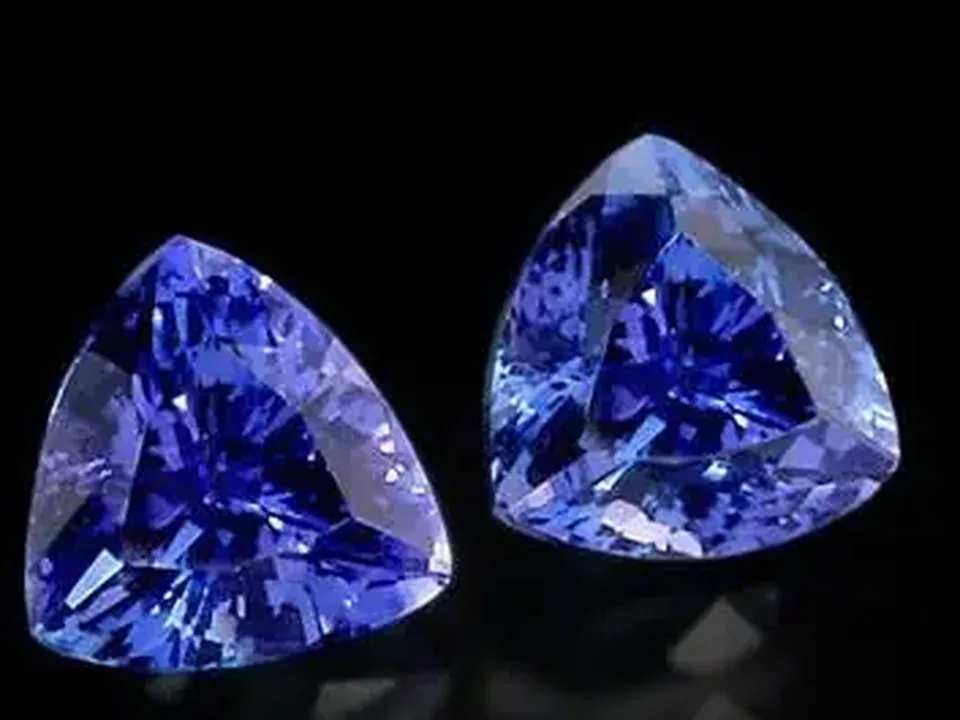
Tanzanite is the blue-to-violet gem variety of zoisite, with the approximate formula Ca₂Al₃Si₃O₁₂(OH). Vanadium contributes to its color. It has a Mohs hardness of about 6.5–7, a refractive index around 1.69–1.70, and pronounced pleochroism: different crystal directions can show blue, violet, and sometimes burgundy or brownish tones. Cut orientation therefore affects the face-up color.
Commercial tanzanite comes from a restricted mining area in northern Tanzania. That geographic fact does not mean every seller’s origin or scarcity statement is independently verified. Read the fuller tanzanite identity and care guide before treating a marketing phrase as evidence.
| Feature | What to examine | Why it matters |
|---|---|---|
| Color | Blue-violet balance in daylight and indoor light | Lighting and orientation can change the apparent hue |
| Cut | Even outline, centered culet, lively face-up appearance | Proportions influence brightness and visible color |
| Setting | Secure prongs or a protective bezel/halo | Reduces exposure to knocks at the girdle |
| Chain | Clasp, links, length, and weight capacity | A fine chain may be mismatched to a heavy pendant |
| Disclosure | Species, treatment, dimensions, metal, return terms | Written details make comparison easier |
2. Ask about identity and treatment
Heating is routine for much of the tanzanite market and commonly changes brownish zoisite into blue-violet material. Heat treatment does not automatically make a stone unsuitable, but it should be represented honestly. Visual inspection cannot reliably establish treatment status. Glass, synthetic substitutes, coated material, or other blue-violet gems may also be sold with confusing language.
Ask the seller to state “natural tanzanite,” known treatments, stone dimensions, carat weight, metal fineness, and whether the stone is assembled or fracture-filled. A basic receipt is not the same as an independent gemological report. For a high-value necklace, request a report from a qualified laboratory or have the piece reviewed by an independent gemologist. Avoid home scratch, heat, or chemical tests; they can damage both stone and mounting.
3. Compare color, cut, clarity, and construction
There is no single “best” tanzanite color for every buyer. Deep blue-violet stones can command attention, while lighter violet-blue stones may look brighter in smaller pendants. View photos or video against neutral backgrounds under more than one light source. Heavily edited images and color labels such as “AAA” are not standardized grades.
Check whether the stone looks lively rather than dark through most of its face. Some inclusions are normal, but surface-reaching fractures may increase wear risk. Inspect prongs for symmetry and contact, and make sure a pointed pear or marquise tip is protected. A pendant is generally less exposed than a ring, yet it can still strike desks, zippers, or other jewelry.
- For frequent wear: favor a bezel, halo, or compact pendant with limited exposed edges.
- For maximum visible color: compare larger stones in ordinary room light, not only spotlighting.
- For gifting: confirm chain length, clasp usability, metal preference, and the return window.
- For higher prices: prioritize traceable documentation over verbal rarity claims.
4. Match the necklace to style and meaning
Tanzanite’s blue-violet range works with white metals for a cool look and yellow or rose gold for warmer contrast. A solitaire emphasizes the stone; a halo increases visual presence; a small station pendant is easier to layer. Common chain lengths are approximately 16 inches near the base of the neck, 18 inches around the collarbone, and 20 inches or longer for a lower drop, although fit varies by body and pendant design.
Tanzanite is often marketed as a December birthstone and as a symbol of transformation, communication, or new beginnings. Those meanings are modern cultural and personal associations, not scientifically verified effects. If the necklace is a gift, a message based on color, occasion, or shared memory is more defensible than promising healing or life outcomes. The GemVerity Gift Finder can help compare occasion and recipient preferences.
5. Plan for realistic care
Mohs hardness measures resistance to scratching; it does not measure toughness, cleavage, heat tolerance, or setting security. Tanzanite has directional cleavage and deserves protection from sharp impacts and sudden temperature changes. Remove the necklace for exercise, sleep, swimming, household chemicals, and work where the pendant may be struck.
When the identity and condition are known, clean gently with lukewarm water, mild soap, and a soft cloth or brush, then rinse cautiously and dry. Avoid steam. Do not use an ultrasonic cleaner unless a qualified jeweler who has inspected the stone and setting says it is appropriate. Store the necklace separately so harder gems cannot scratch it and the chain cannot tangle. See the site’s care guides for broader handling principles.
Buying checklist
- Compare the face-up color in neutral daylight and indoor light.
- Confirm the pendant does not show a large dead or windowed area.
- Check prongs, protective edges, bail, chain links, clasp, and metal marks.
- Get identity, known treatment, dimensions, metal, and return policy in writing.
- For a consequential purchase, obtain independent documentation.
Frequently asked questions
Is tanzanite durable enough for a necklace?
Yes, tanzanite can be suitable for a necklace because a pendant is usually less exposed than a ring, but its Mohs hardness of about 6.5–7 does not prevent chipping. A protective setting and careful wear are sensible.
Is heat-treated tanzanite real tanzanite?
Yes. Heat-treated natural tanzanite remains tanzanite. Heating is common in the market, but the seller should disclose known treatment rather than presenting it as proof of exceptional rarity.
What color tanzanite necklace should I choose?
Choose the blue-violet balance you prefer after viewing it in several lighting conditions. Deep saturation may be valued, but brightness, cut quality, size, and personal taste also matter.
Should a tanzanite necklace come with a laboratory report?
A report is not essential for every modest purchase, but it becomes more useful as price, rarity, origin, or treatment claims become significant. Independent documentation is stronger than a seller grade alone.
Choose evidence before labels
A secure design, transparent disclosure, and a realistic care plan make a better foundation than an unstandardized quality grade.