Stone library / visual browsing
Stone identification by color
Color is the fastest way to narrow a mystery stone, but it is not a final identification. Start with the visible body color, then compare transparency, pattern, luster, hardness, and any treatment disclosure.
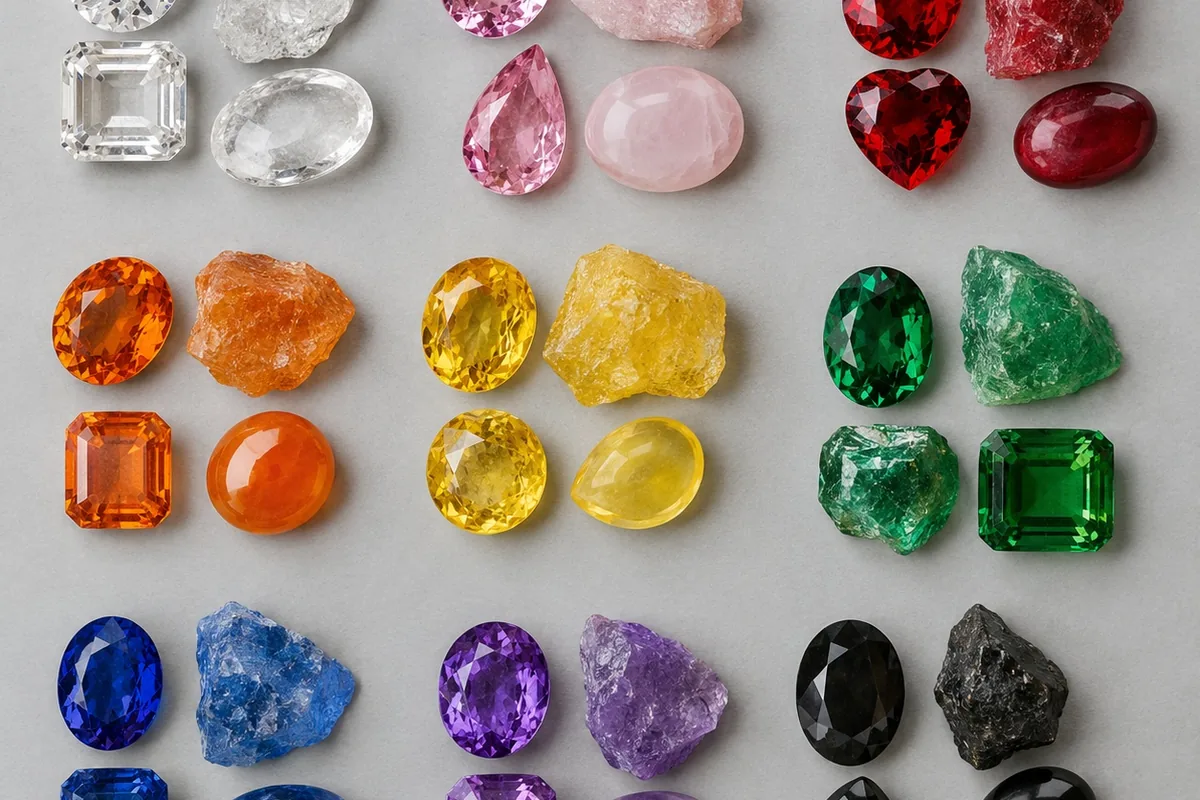
How to identify a crystal by color
- Choose the main body color. Ignore the background, metal setting, camera filter, and reflected light. Check the piece in neutral daylight if possible.
- Compare more than hue. Note transparency, luster, bands, inclusions, cleavage, and optical effects such as sheen or color play. Purple quartz and purple fluorite, for example, can overlap in color but differ in hardness, cleavage, and structure; green aventurine, jade, glass, and included quartz can also look similar in a photo.
- Confirm with material evidence. Open the closest guide, review treatments and trade names, and use gemological testing or a qualified professional when identity affects safety, care, or price.
Color narrows a shortlist; it does not complete an identification. Also review misleading crystal trade names before treating a seller label as a mineral name.
Quick answer
Gemstone color identification chart
| Color | Common possibilities | Useful visual clues |
|---|---|---|
| Blue / green | Aquamarine, emerald, amazonite, malachite | Aquamarine is usually transparent and pale; emerald is richer green and commonly included; amazonite is opaque with pale streaks; malachite has curved green banding. |
| Pink / red | Rose quartz, strawberry quartz, garnet, rhodochrosite | Rose quartz is cloudy and pale; strawberry quartz shows red inclusions; garnet is often transparent to translucent and dark red; rhodochrosite commonly shows pink-and-white bands. |
| Purple | Amethyst, fluorite, charoite, lepidolite | Amethyst is glassy and may show color zoning; fluorite often has straight cleavage or multicolor bands; charoite has swirling fibrous patterns; lepidolite has a micaceous sparkle. |
| White / clear | Clear quartz, moonstone, selenite, opal | Quartz is glassy; moonstone may show a floating sheen; selenite is very soft and fibrous; opal can show play-of-color or a waxier luster. |
| Black / dark | Obsidian, black tourmaline, onyx, black jade | Obsidian has a glassy fracture; tourmaline crystals often have lengthwise striations; onyx may be finely banded; jade is tough with a compact, less glassy appearance. |
Important: lighting, camera white balance, dye, coatings, and trade names can all distort color. Do not use a photo or color alone to make a purchase, value, or safety decision.
Is a blue-green beryl aquamarine or emerald?
Both aquamarine and emerald are varieties of beryl, with a Mohs hardness of about 7.5–8. Aquamarine usually appears pale blue to blue-green and is often relatively transparent. Emerald is green to bluish green, commonly more saturated, and frequently contains visible inclusions sometimes described in the trade as a jardin.
Color depth is not enough to separate them. Ask for the seller's identification and treatment disclosure, and use refractive-index or other gemological testing when the distinction affects price.
How to spot dyed or coated color
- Look for color concentration: dye may collect in fractures, drill holes, pits, or between bead surfaces.
- Question neon uniformity: unusually bright, perfectly even color at a very low price deserves closer inspection.
- Check the listing language: look for dyed, coated, stabilized, irradiated, heat-treated, reconstructed, or synthetic disclosures.
- Avoid destructive home tests: acetone, scratching, heat, and soaking can damage a stone, coating, setting, or string. A gemologist can test valuable or sentimental pieces safely.
Crystal color meanings: folklore, not identification
Some modern crystal traditions associate pink and green with love, blue with communication, purple with intuition, and black or red with grounding. These are cultural or folkloric beliefs, not scientific or medical facts. Color symbolism cannot identify a mineral or establish health effects.
Red stones
Red
Garnet
Red is common, but garnet occurs in several colors and species.
Carbonate mineralRhodochrosite
Pink to red tones with relatively gentle wear limits.
Safety-sensitive materialCinnabar
Vivid red mineral requiring material-specific handling.
Tourmaline varietyRubellite Tourmaline
Red to pink-red tourmaline with tourmaline-group care questions.
Included quartzRed Included Quartz
Quartz with red rutile or hematite inclusions; identity depends on inclusion type.
Included quartzRed Phantom Quartz
Quartz with red internal phantom layers from mineral inclusions.
Included quartzRed Rabbit Hair Quartz
A commercial label for quartz with fine red needle-like inclusions.
Agate varietyNanhong Agate
A red agate variety with a specific geographic and market identity.
Spinel familySpinel
Red is a classic spinel color, often historically confused with ruby.
Quartz varietyStrawberry Quartz
Quartz with red hematite or iron oxide inclusions giving a strawberry appearance.
Pink stones
Pink
Rose Quartz
Soft pink quartz with common inclusions and treatment questions.
Beryl varietyMorganite
Peach to pink beryl, often compared with other beryl gems.
Spodumene varietyKunzite / Spodumene
Pink to lilac material with color and care considerations.
Tourmaline varietyRubellite Tourmaline
Pink to red tourmaline, spanning both pink and red color sections.
Carbonate mineralRhodochrosite
Pink to red banded material; appears in both red and pink sections.
Agate varietyCherry Blossom Agate
Pale pink agate with flower-like inclusions, popular in bead jewelry.
Trade materialStar Rose Quartz
A trade label for rose quartz displaying asterism; verify identity per specimen.
Trade nameRose Stone
A commercial label needing sample-specific mineral identification.
Orange stones
Orange
Orange Moonstone
Peach to orange body color with feldspar care limits.
Feldspar varietySunstone
Warm color and aventurescence can vary by specimen.
Quartz varietyCitrine
Yellow-orange quartz with important treatment disclosure questions.
Garnet varietySpessartine Garnet
Orange to reddish-orange garnet, sometimes called mandarin garnet.
Fossil resinAmber
Yellow to orange fossil resin; appears in both orange and yellow sections.
Silicate mineralTopaz
Orange and golden-orange are among topaz's possible body colors.
Yellow stones
Yellow
Citrine
Yellow quartz with natural and heated material kept distinct.
Fossil resinAmber
Yellow to orange fossil resin, not a mineral crystal.
Silicate mineralTopaz
Yellow is one of several possible topaz colors.
Chalcedony varietyYellow Chalcedony
Yellow to golden chalcedony with quartz-group durability.
Included quartzGold Included Quartz
Quartz with golden rutile needles; the inclusion color creates the visual impression.
Feldspar varietySunstone
Golden to orange feldspar; appears in both yellow and orange sections.
Green stones
Green
Peridot
Characteristic green olivine with a distinct material identity.
Copper carbonateMalachite
Banded green material with softer wear and care limits.
Silicate mineralPrehnite
Pale yellow-green to green material with varied transparency.
Quartz varietyGreen Aventurine Quartz
Green quartz with fuchsite mica inclusions creating aventurescence.
Garnet varietyTsavorite Garnet
Vivid green grossular garnet with high brilliance.
Garnet varietyDemantoid Garnet
Green andradite garnet, often with distinctive horsetail inclusions.
Included quartzGreen Included Quartz
Quartz with green mineral inclusions; identity depends on inclusion type.
Included quartzGreen Phantom Quartz
Quartz with green internal phantom layers from chlorite or other minerals.
Jade varietyNephrite Jade
Green is the most familiar nephrite color, though other tones occur.
Jade varietyJadeite Jade
Green jadeite is iconic, but jadeite occurs in several colors.
Serpentine jadeXiuyan Jade
Yellow-green to green serpentine material with distinct care limits.
Impact glassMoldavite
Olive-green natural glass formed by meteorite impact.
Feldspar varietyAmazonite
Green to blue-green feldspar; appears in both green and blue sections.
Blue stones
Blue
Aquamarine
Blue to blue-green beryl, often assessed for clarity and color.
Rock aggregateLapis Lazuli
Deep blue aggregate material with pyrite and calcite context.
Phosphate mineralTurquoise
Blue to green-blue material where treatment disclosure matters.
Silicate mineralKyanite
Often blue, with directional hardness and cleavage concerns.
Pectolite varietyLarimar
Soft blue to blue-green pectolite from a single geographic source.
Zoisite varietyTanzanite
Blue to violet-blue zoisite; heat treatment is the industry norm.
Feldspar varietyAmazonite
Blue-green to green feldspar; appears in both blue and green sections.
Chalcedony varietyBlue Chalcedony
Blue to gray-blue chalcedony with quartz-group durability.
Man-made glassBlue Goldstone
A synthetic glass with copper crystals, not a natural mineral.
Trade materialBlue Needle Quartz
A commercial label for quartz with blue needle-like inclusions.
Trade materialBlue Lace Stone
A commercial label needing sample-specific mineral identification.
Phosphate mineralApatite
Blue is a common apatite color; softer wear limits apply.
Tourmaline varietyParaiba Tourmaline
Electric blue to green copper-bearing tourmaline with a specific origin context.
Purple stones
Purple
Amethyst
Purple quartz with color zoning and heat-treatment context.
Silicate materialCharoite
Lavender to purple material with a distinctive fibrous appearance.
Silicate mineralSugilite
Purple material that varies in color, translucency, and matrix.
Zoisite varietyTanzanite
Violet-blue to purple-blue; appears in both blue and purple sections.
Trade materialPurple Mica
A commercial label for purple micaceous material; verify identity per specimen.
Spodumene varietyKunzite / Spodumene
Pink to lilac; appears in both pink and purple sections.
Brown stones
Brown
Smoky Quartz
Brown to gray-brown quartz with natural or induced color.
Quartz varietyTiger's Eye
Golden-brown chatoyant quartz with distinctive silky luster.
Quartz varietyHawk's Eye
Blue-gray to brown chatoyant quartz; the blue-gray variety is hawk's eye.
Quartz varietyPietersite
Brecciated chatoyant quartz with brown, gold, and blue-gray tones.
Volcanic glassObsidian
Mahogany obsidian shows brown and black banding; also appears in black section.
Gray stones
Gray
Labradorite
Gray body color with colorful labradorescence; the flash is the feature.
Feldspar varietyMoonstone
White to gray feldspar with an optical sheen; also in white section.
Quartz varietyHawk's Eye
Blue-gray chatoyant quartz; appears in both brown and gray sections.
Quartz varietySmoky Quartz
Gray-brown quartz; appears in both brown and gray sections.
Iron meteoriteGibeon Iron Meteorite
Metallic gray with Widmanstatten pattern; not a terrestrial mineral.
Black stones
Black
Black Tourmaline
Commonly black schorl with tourmaline-specific care questions.
Volcanic glassObsidian
Black volcanic glass, not a crystalline mineral.
Market labelBlack Jade
A label that needs a sample-specific mineral identification.
Included quartzBlack Included Quartz
Quartz with black tourmaline or other dark mineral inclusions.
White and clear stones
White & clear
Clear Quartz
Colorless quartz with inclusions and clarity variations.
Feldspar varietyMoonstone
White to gray feldspar with an optical sheen.
Hydrated silicaOpal
White body color can occur with or without play-of-color.
Included quartzWhite Phantom Quartz
Quartz with white internal phantom layers; the phantom is the visual feature.
Quartz varietyChalcedony
White to pale blue-gray chalcedony is common; dyed colors are also frequent.
Stones with varied or multiple colors
Multicolor
Tourmaline
One mineral group expressed in many colors and varieties.
Halide mineralFluorite
Often color-zoned or available in several body colors.
Tourmaline varietyWatermelon Tourmaline
Green and pink zoning is a visual feature, not an identity test.
Chalcedony varietyAgate
Banding and colors vary greatly; bright color can require treatment questions.
Hydrated silicaOpal
Play-of-color can display the full spectrum; also appears in white section.
Trade materialRuby-Zoisite
Green zoisite matrix with red ruby crystals; a naturally multicolor material.
Feldspar varietyLabradorite
Gray body with multicolor labradorescence; also in gray section.
Trade nameSuper Seven Quartz
A commercial label for quartz with multiple mineral inclusions in varied colors.
Quartz varietyPietersite
Multicolor brecciated chatoyant quartz; also in brown section.
Trade materialPhoenix Stone
A commercial label for multicolor material; verify identity per specimen.
Included quartzCopper-Colored Included Quartz
Quartz with copper-colored inclusions creating a distinctive warm tone.
Chrysoberyl varietyCat's-eye Chrysoberyl
Chatoyant chrysoberyl in yellow-green to honey tones with a sharp eye line.
Frequently asked questions
Can I identify a gemstone only by its color?
No. Color narrows the possibilities, but many minerals occur in several colors and unrelated materials can look alike. Confirm with transparency, pattern, hardness, specific gravity, refractive index, and professional testing when needed.
Why is my pink or purple stone fading?
Some materials and treatments can fade with prolonged light or heat exposure. Amethyst and kunzite are notable examples. Store colored stones away from sustained direct sunlight and follow the care guidance for the confirmed material.
How can I tell whether a stone is dyed?
Inspect fractures, pits, drill holes, and bead edges for concentrated color, and check the seller's treatment disclosure. Avoid solvent or scratch tests on jewelry; they can cause permanent damage.
What should I record before asking for help?
Photograph the stone in indirect daylight, note whether it is transparent or opaque, describe bands or inclusions, record approximate size and weight, and include any hallmark, label, or seller disclosure.