Stone library / Quartz & Silica / Quartz Varieties with Inclusions
Green Rutile Quartz (Green Included Quartz)
A practical guide to a commercial name used for quartz with green inclusions—what the label can and cannot identify, how to care for it, and what to verify before buying.
Identity note: “Green rutile quartz” is a seller-facing trade label, not a precise mineral species. Green needles or fibers may be actinolite, chlorite, tourmaline, epidote, or another inclusion; appearance alone cannot prove rutile.
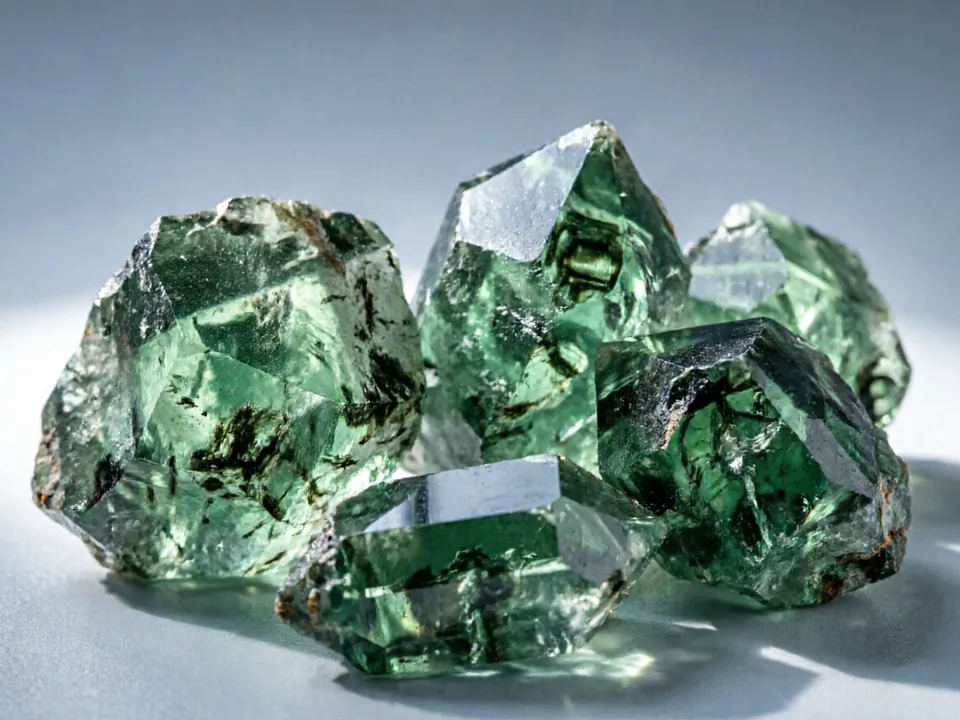
What is green rutile quartz?
The host material is quartz, with chemical formula SiO₂ and a Mohs hardness of about 7. The green material is included within the quartz, but the commercial name does not establish which inclusion mineral is present.
Rutile itself is titanium dioxide (TiO₂), yet not every green needle in quartz is rutile. For a valuable or disputed specimen, microscopic examination and methods such as Raman spectroscopy are stronger evidence than color, shape, or a sales label.
What gives it its color?
Green inclusions can create needles, fibers, clouds, moss-like patches, or layered patterns. Reported inclusion minerals in green included quartz include actinolite, chlorite, green tourmaline, and epidote. These possibilities are not interchangeable, so describe an untested piece as quartz with green inclusions rather than assigning a mineral from a photograph.
Where does it come from?
Included quartz is sold from multiple mining regions, and a broad trade label does not prove geographic origin. Ask for locality documentation if origin affects the price; otherwise treat country claims as seller-provided information rather than a visual identification.
Treatments and how to spot them
Do not assume every specimen is untreated. Quartz may be dyed, coated, fracture-filled, assembled, or represented under an imprecise trade name. Surface-reaching color concentrations, coating wear, bubbles, glue lines, or an unusually uniform pattern can justify closer inspection, but none is a complete home test.
Important: Visual clues cannot replace refractive index, specific gravity, microscopy, spectroscopy, or a qualified laboratory report. Ask the seller to state the host material, proposed inclusion identity, treatments, and return policy in writing.
Jewelry and care tips
Quartz is scratch-resistant enough for many jewelry uses, but internal fractures and inclusions can make a particular piece less resistant to impact. Clean briefly with lukewarm soapy water and a soft cloth only when the construction allows it. Avoid steam, sudden temperature changes, prolonged soaking, and ultrasonic cleaning when fractures, fillings, glue, drilled beads, elastic cord, or an unknown treatment may be present.
Store the piece so harder gems cannot scratch it, and inspect bead holes, prongs, glue joints, and cord before wearing. Mohs hardness measures scratch resistance; it does not guarantee that an included or assembled piece is safe from heat, impact, or immersion.
Cultural beliefs and symbolism
Green Rutile Quartz carries cultural meaning across many traditions — these are folkloric and cultural traditions, not scientifically verified properties. Its associations vary by culture, and its use in astrology, chakra, or feng shui contexts should be understood as cultural expression rather than factual claims.
What affects its value?
Price can reflect the visual pattern, contrast, transparency of the quartz, workmanship, size, condition, and confidence in the material description. A dramatic green needle pattern is not proof of rutile, origin, rarity, or treatment status.
Before buying: request close-up images, dimensions, disclosure of treatments or assembly, the seller’s basis for naming the inclusions, and a return policy. For a high-value piece, an independent laboratory report is stronger evidence than a commercial label.
Use this guide as a starting point
For a costly or disputed stone, ask for species, treatment, and origin information in writing. An independent laboratory report is stronger evidence than a marketing phrase.
Return to Quartz & SilicaSources and review framework: GIA quartz overview, GIA reports on actinolite inclusions in quartz and green tourmaline in quartz, plus the GemVerity editorial method. This educational page does not identify a specific specimen. Cultural beliefs are traditions, not scientific guarantees.