Care desk / cleaning
How to clean crystal jewelry safely
There is no single rule that works for every stone. The safest cleaning method depends on three things: how hard the material is, whether it has cleavage or fractures, and whether it has been treated, dyed, filled, or coated.
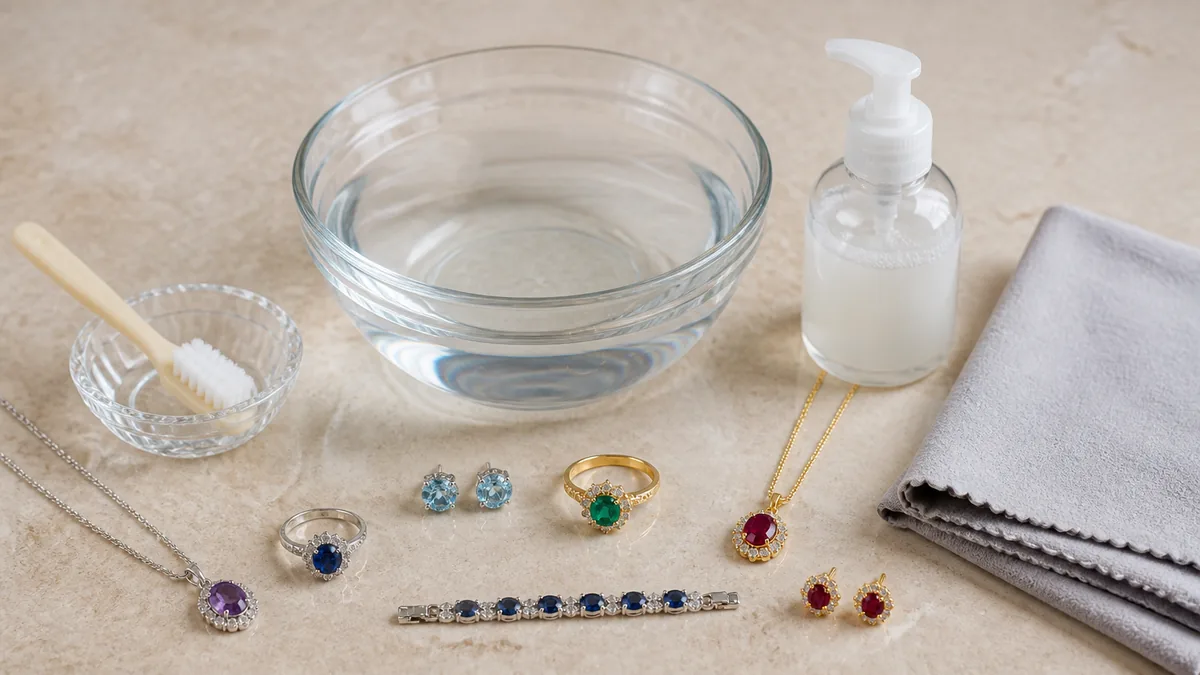
Start with the gentlest option
The default for most jewelry is warm water, a few drops of mild dish soap, and a soft brush or cloth. This is safe for the majority of stones that are reasonably hard, untreated, and free of heavy fractures. Rinse briefly and pat dry rather than rubbing hard.
If you are unsure what a stone is, or whether it is treated, stop at a dry soft cloth. A wrong cleaning method can do more damage than the dirt it was meant to remove.
When to avoid water entirely
Some materials should never be soaked or cleaned with water, because water can damage the material itself or the treatment holding it together:
- Porous or soft stones such as malachite, rhodochrosite, turquoise (especially untreated), and other carbonates or phosphates can absorb water and be dulled or etched.
- Opals contain water and can crack if they dry too quickly or are soaked with detergents.
- Assembled stones such as doublets and triplets can be damaged at the seam by water or solvents.
- Dyed stones can leach color, and oiled or filled stones can lose their treatment.
For these, a dry or barely damp cloth is the right tool.
Ultrasonic and steam: usually a "no"
Ultrasonic cleaners and steam cleaners are aggressive, and they are a common cause of cracked or chipped stones. Avoid them for any stone that is soft, has cleavage, is heavily included, or is treated. This includes nearly everything in the ornamental and trade-name categories.
Only hard, untreated, relatively inclusion-free stones should even be considered, and even then, a qualified jeweler should make the call on a valuable piece.
What to avoid as a shortcut
Household tricks are risky. Toothpaste, baking soda, and abrasive dips remove tarnish by removing material, which on a plated or soft stone means removing the finish itself. Clear nail polish "sealing" can yellow, peel, or trap moisture. If a piece is valuable, skip the shortcuts.
Related: hardness and toughness explained and natural versus treated stones.