Jewelry guide / labradorite
Why Doesn’t Every Labradorite Bead Flash?
Editorial disclosure: GemVerity provides independent educational guidance. The images on this page are illustrative and cannot authenticate a stone, treatment, or seller listing.
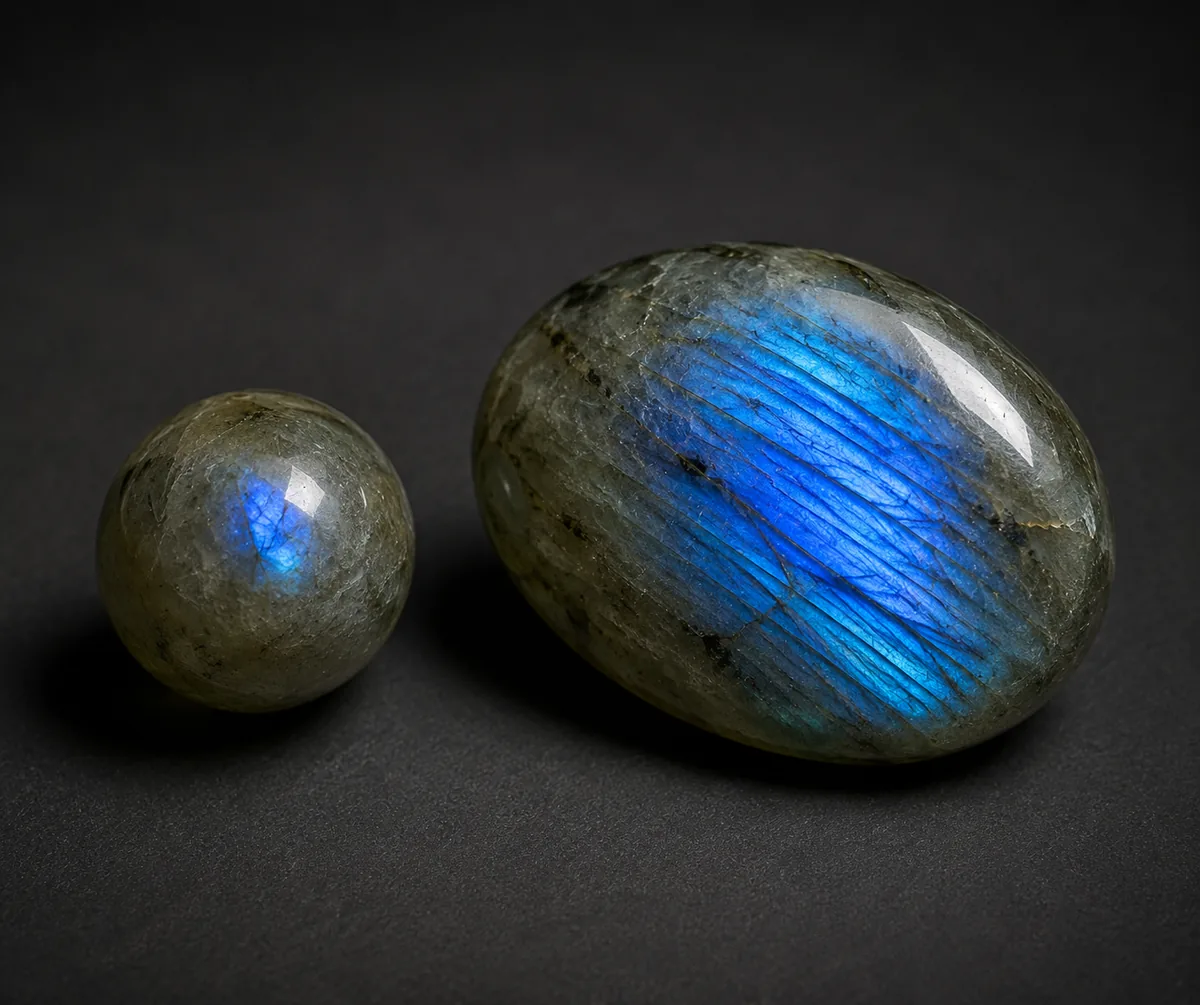
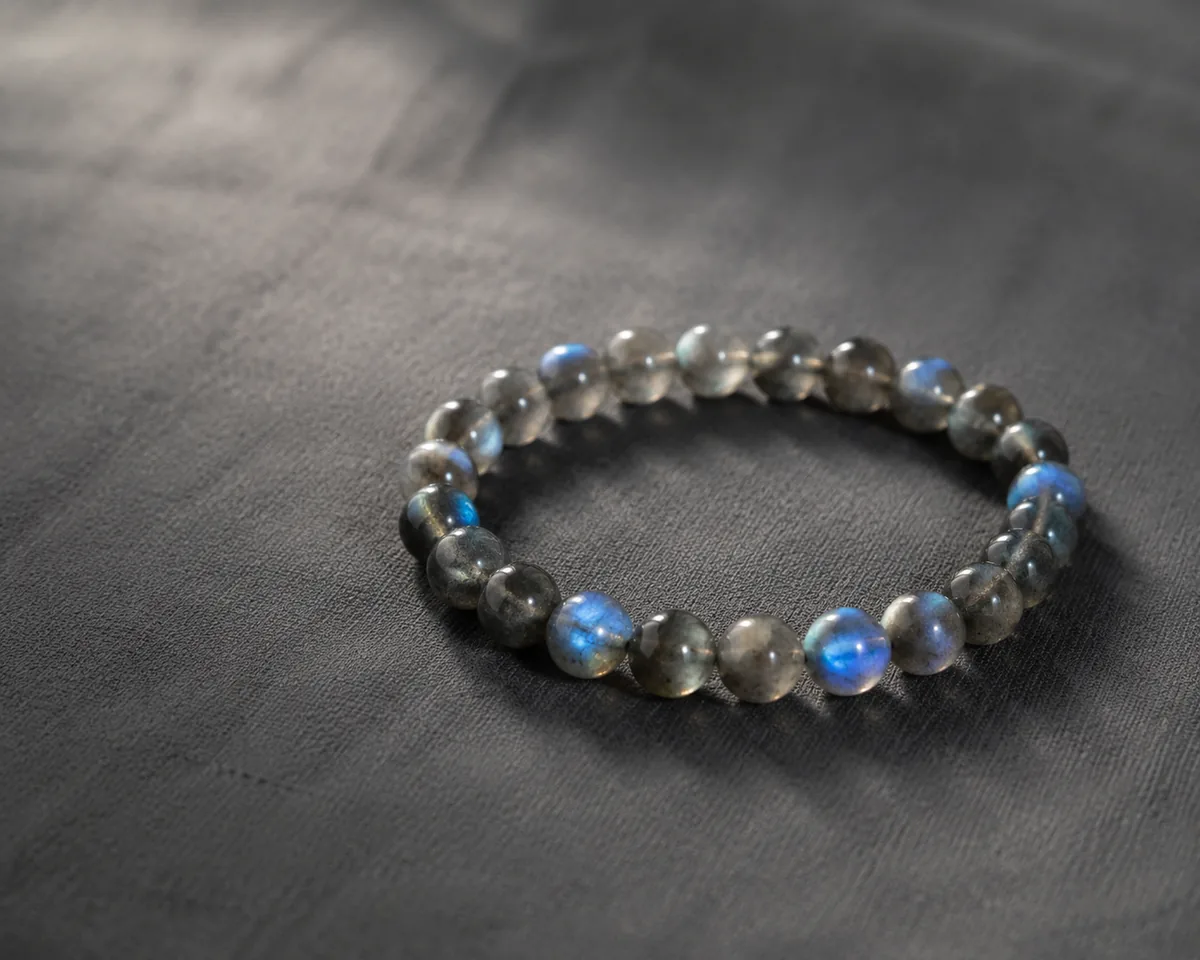
A genuine labradorite bracelet does not need every bead to glow from every direction. Labradorescence is directional: the flash appears only when the light, your eye, and a bead’s internal layers align. Round beads point those layers in different directions, so some look blue or green while neighboring beads remain gray until the bracelet moves.
Quick answer
Do not judge a labradorite bracelet from one front-facing photo. Ask for a slow video in neutral daylight, look for flash across several viewing angles, and inspect polish, chips, drill holes, cord, and metal disclosures. Uniform blue in a seller image is a reason to ask questions—not proof of imitation by itself.
Labradorite bracelet facts at a glance
| Question | Practical answer |
|---|---|
| Why does the flash move? | Light interferes within fine internal feldspar lamellae, producing directional labradorescence. |
| Why do round beads differ? | Each sphere presents its internal layers at a different orientation to the light and viewer. |
| Does every bead need blue flash? | No. Coverage, brightness, color, cutting, condition, and disclosure all matter. |
| Hardness | About 6–6.5 on the Mohs scale; hardness measures scratch resistance, not resistance to chipping. |
| Main care concern | Cleavage, impacts, surface abrasion, drill holes, cord, and metal components. |
What causes labradorescence?
Labradorite is a feldspar. As the material forms and cools, fine internal lamellae with different compositions can develop. Light interacting with this layered structure produces optical interference, creating the blue, green, gold, or other colors called labradorescence.
The effect is strongly directional. A small change in illumination, camera position, or viewing angle can make a bright area disappear. That is why a bracelet may look subdued indoors and suddenly flash when the wrist turns near a window.
For the mineral background, see the Labradorite guide.
Why round beads behave differently from cabochons
A lapidary can orient a broad, flat cabochon face to display a large sheet of color. A spherical bead has no single flat viewing face. Its curved surface and the orientation of the rough mean the strongest flash may occupy only a small area or appear from one or two directions.
Beads in one bracelet are also drilled and strung at different orientations. Turning the bracelet is therefore part of evaluating it; a static image cannot show the complete optical performance.
How to assess flash in neutral light
- Use indirect daylight or a neutral white light rather than colored LEDs.
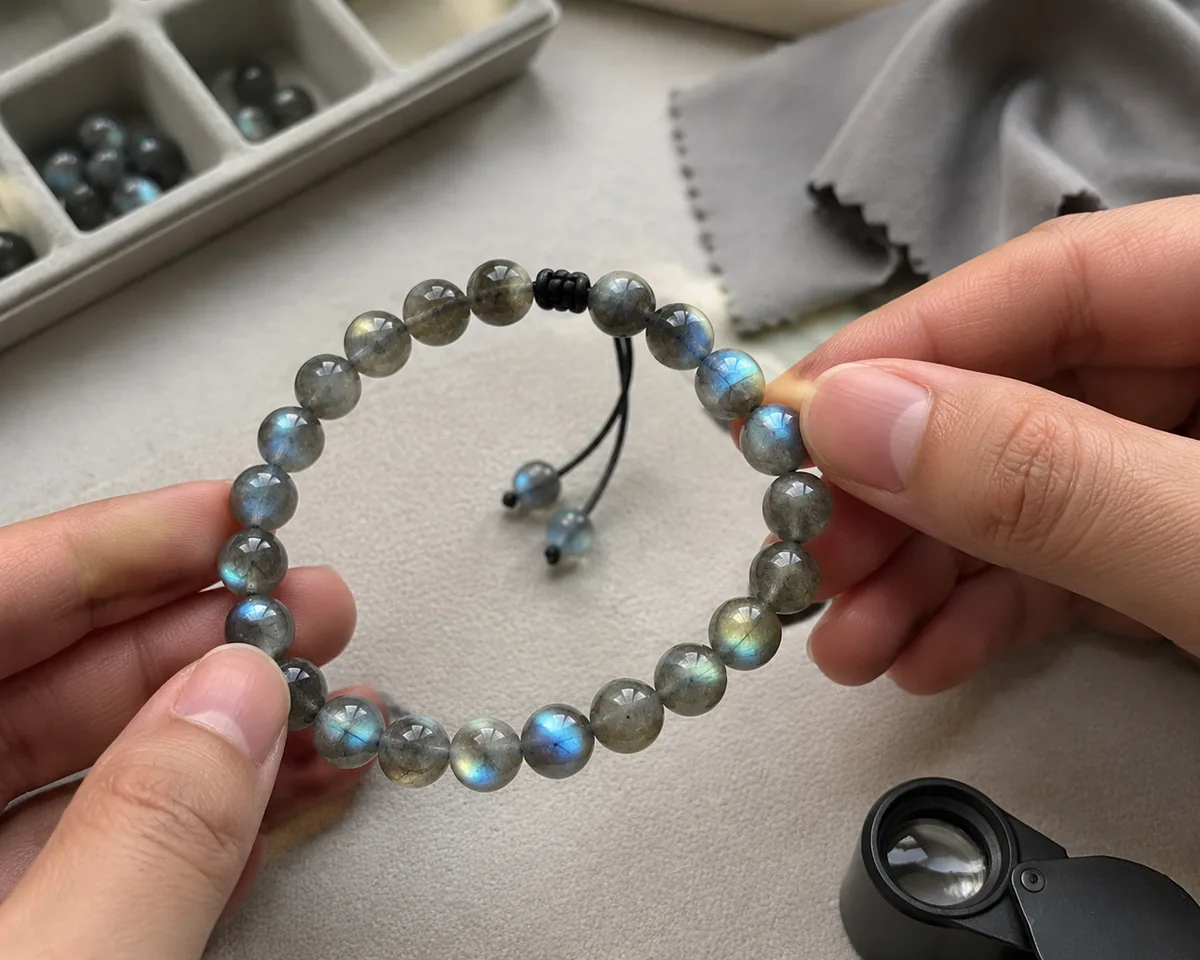
- Rotate the bracelet slowly through a full turn while keeping the light position steady.
- Check how many beads flash, how broad the visible areas are, and whether the effect remains attractive from normal wearing angles.
- Repeat from another light direction. Directional flash should change as the geometry changes.
- Ask whether seller photos or videos use filters, strong spotlights, coatings, or color enhancement.
Quality checklist beyond blue flash
- Flash coverage and brightness: Strong blue is popular, but broad coverage is not the only quality factor.
- Body appearance: Compare translucency, gray body color, zoning, and consistency under neutral light.
- Surface finish: Look for a smooth polish without obvious flat spots, abrasions, or chipped drill holes.
- Internal condition: Natural features may be present. Open or surface-reaching fractures can affect durability and should not be marketed as proof of quality.
- Construction: Inspect elastic, knots, clasps, spacers, and bead-hole edges.
- Disclosure: Ask for the exact stone, treatments, coatings, and metal composition rather than relying on “natural,” “premium,” or “hypoallergenic.”
Imitations, coatings, and misleading photos
Glass, coated material, composites, and other products can imitate parts of labradorite’s appearance. At the same time, genuine material can look unusually bright under a concentrated light or edited photo. Uniform color is therefore a prompt to request neutral-light video and treatment disclosure, not a stand-alone identification test.
No single home observation proves authenticity. For a valuable, disputed, or unusually described bracelet, request seller documentation or consult a qualified gemologist. The guide to misleading crystal trade names explains what to verify in a listing.
How to care for a labradorite bracelet
Labradorite is about 6–6.5 on the Mohs scale and has cleavage, so it can scratch, chip, or split after abrasion or a sharp impact. Mohs hardness is not a complete measure of toughness; see hardness versus toughness.
- Remove the bracelet for exercise, lifting, household work, swimming, showering, and impact-heavy activities.
- Avoid rubbing it against harder gemstones, abrasive dust, or metal watch edges.
- Keep perfume, lotion, cleaners, chlorine, and prolonged moisture away from the complete bracelet.
- Wipe with a soft cloth. If needed, use brief lukewarm water and mild soap, then dry the beads, holes, cord, and metal thoroughly.
- Use conservative care: avoid steam and ultrasonic cleaning unless a qualified professional has assessed the entire piece.
For a general process, read how to clean crystal jewelry.
Frequently asked questions
Is a labradorite bracelet fake if only a few beads flash?
No. Directional flash and different bead orientations can make only some beads light up at one moment. Identity still cannot be confirmed from flash alone.
Is blue flash always the most valuable?
Blue is popular in retail listings, but value also depends on coverage, brightness, body clarity, cutting, condition, treatment disclosure, construction, and buyer preference.
Are black specks proof that the stone is natural?
No. Dark specks and other internal features may occur naturally, but their mineral identity and the stone’s authenticity cannot be established by appearance alone.
Can I wear labradorite every day?
It can be worn regularly with mindful care, but bracelets receive frequent knocks. Remove it for water, chemicals, exercise, chores, and situations where it may strike a hard surface.
Can sterling silver or titanium guarantee sensitive-skin comfort?
No jewelry metal is guaranteed allergy-free. Ask for exact alloy and grade documentation; “implant-grade titanium” should be verifiable rather than used as a vague marketing phrase.
Bottom line
A good labradorite bracelet should reward movement, not look uniformly illuminated in every frame. Evaluate it through neutral-light video, realistic flash coverage, sound polishing and construction, and clear material disclosures. Gentle handling will help preserve its polish and appearance.
Sources and editorial boundary
- GIA: Optical Effects of Phenomenal Cabochons
- GIA: Tips for Caring for Jewelry
- Geology.com: Labradorite
Last reviewed: 2026-08-28. This article provides educational buying and care guidance, not gemological identification or a guarantee about any pictured or listed product.