Zodiac traditions / birthstone chart
Zodiac Birthstone Chart: Monthly vs Sun-Sign Stones
There is no single official zodiac birthstone chart. Monthly birthstones follow a relatively stable modern retail list. Sun-sign stones are a cultural and commercial tradition with several competing versions. The useful question is not “which chart is official?” but “which system am I actually trying to use?”
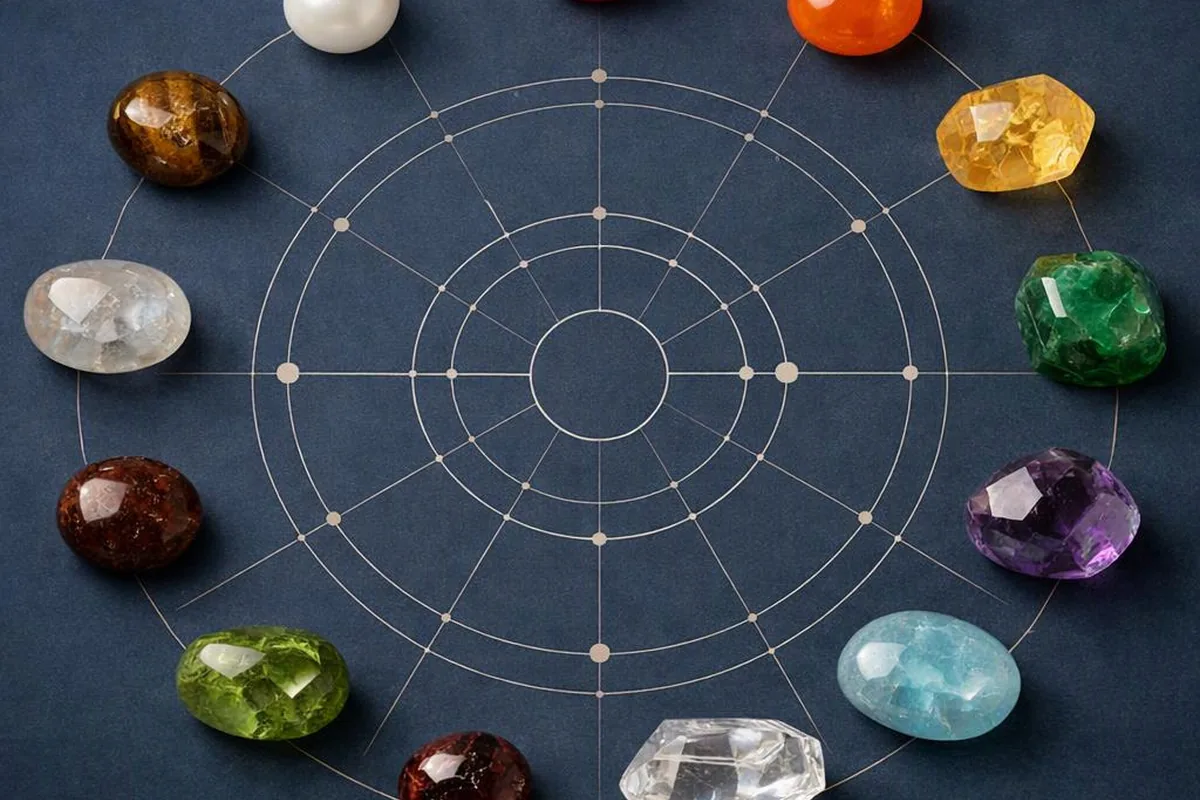
Quick answer: use the month for a birthday, the sign for a style story
If you are choosing a traditional birthday gift, start with the monthly birthstone. If you are choosing a piece because someone identifies with a sun sign, use the sign’s commonly listed stones as a symbolic and stylistic starting point. Neither system identifies a mineral, proves a treatment, or guarantees an outcome.
A July birthday has ruby as the modern monthly birthstone. A Leo is often paired with peridot in modern zodiac lists, while a 1913 zodiac list gives Leo onyx. None of those is “the real one” without a stated tradition. The chart below shows the disagreement instead of hiding it.
The three lists behind most zodiac birthstone charts
Most pages you will find online combine three different ideas without saying so:
- A modern “majority month” list. Because a sign usually starts in one month and ends in the next, some retailers assign the birthstone of the month that contains more of the sign’s dates. Aries, for example, runs from March 21 to April 19, so this method gives Aries April’s diamond.
- The month stones touched by the sign’s dates. A sign that spans two months may be listed with stones from both months. June and December are especially messy because each has multiple modern birthstones.
- An older zodiacal list. A 1913 list often attributed to George Frederick Kunz uses a different set: bloodstone for Aries, sapphire for Taurus, agate for Gemini, emerald for Cancer, onyx for Leo, carnelian for Virgo, chrysolite for Libra, beryl for Scorpio, topaz for Sagittarius, ruby for Capricorn, garnet for Aquarius, and amethyst for Pisces.
Those lists overlap, but they are not the same system. A retailer may also choose one of several birthstones for a month, which is why Sagittarius can appear with turquoise on one chart and tanzanite on another.
Zodiac birthstone chart for all 12 signs
The table compares one common modern retail approach, the month stones inside each sign’s date range, and the 1913 list. Dates are approximate and can shift by a day depending on the year and time zone. “Majority month” is a retail convention, not an official standard.
| Sign and dates | Modern majority-month stone | Month stones its dates touch | 1913 zodiacal list |
|---|---|---|---|
| Aquarius Jan 20 – Feb 18 | Amethyst | Garnet, amethyst | Garnet |
| Pisces Feb 19 – Mar 20 | Aquamarine | Amethyst, aquamarine | Amethyst |
| Aries Mar 21 – Apr 19 | Diamond | Aquamarine, bloodstone, diamond | Bloodstone |
| Taurus Apr 20 – May 20 | Emerald | Diamond, emerald | Sapphire |
| Gemini May 21 – Jun 20 | Pearl | Emerald, pearl, moonstone, alexandrite | Agate |
| Cancer Jun 21 – Jul 22 | Ruby | Pearl, moonstone, alexandrite, ruby | Emerald |
| Leo Jul 23 – Aug 22 | Peridot | Ruby, peridot, spinel, sardonyx | Onyx |
| Virgo Aug 23 – Sep 22 | Sapphire | Peridot, spinel, sardonyx, sapphire | Carnelian |
| Libra Sep 23 – Oct 22 | Opal | Sapphire, opal, tourmaline | Chrysolite |
| Scorpio Oct 23 – Nov 21 | Topaz | Opal, tourmaline, topaz, citrine | Beryl |
| Sagittarius Nov 22 – Dec 21 | Turquoise or tanzanite | Topaz, citrine, turquoise, zircon, tanzanite | Topaz |
| Capricorn Dec 22 – Jan 19 | Garnet | Turquoise, zircon, tanzanite, garnet | Ruby |
“Chrysolite” in the 1913 list is an old trade name most often used for peridot. Modern birthstone lists also vary by country and by jeweler; the table is a comparison tool, not a grading standard.
Monthly birthstones are a separate system
The modern monthly list is usually traced to a 1912 list standardized by the National Association of Jewelers, with later additions such as tanzanite for December in 2002. The GIA birthstone reference is a useful current source for the month list. It is a retail and cultural convention, not a mineral classification.
That relative stability is why a birthday gift is easier to justify with a monthly stone. If someone was born in July, ruby is the conventional modern answer regardless of whether they are a Cancer or a Leo. A zodiac chart adds a second layer: Cancer is often paired with ruby, pearl, moonstone, or emerald depending on the list; Leo is often paired with peridot, ruby, onyx, or sunstone.
For the month-by-month index, use the birthstone browser. For the cultural sign index, use zodiac stones by sign.
Why the charts disagree
There are five ordinary reasons, none of which requires a conspiracy:
- No official body sets zodiac stones. The month list has a widely repeated modern standard; the sign list does not. Different publishers can legitimately choose different stones.
- The majority-month rule is a choice. Assigning Aries to April’s diamond is a retail convenience, not an ancient rule. Another list may stay with March’s aquamarine or use a traditional bloodstone.
- Some months have several birthstones. June has pearl, moonstone, and alexandrite; December has turquoise, zircon, and tanzanite. A sign touching those months can inherit any of them.
- Old trade names survive. “Chrysolite” usually means peridot in older lists; “beryl” can point to several gem varieties. A modern reader may not recognize the old label.
- Sign dates are not perfectly fixed. The sun’s entry into a sign can vary by a day with the year and time zone. People born on a cusp may find different dates on different sites.
The honest conclusion is simple: a zodiac stone chart is a cultural map, not a specification sheet. If a seller presents one list as the only correct one, ask what tradition or source they are using.
How to choose without chasing a “correct” list
| Your situation | Start with | Then check |
|---|---|---|
| A birthday gift | The recipient’s birth month | Their usual metal, color preferences, ring or necklace habits, and care tolerance |
| A self-purchase tied to a sign | A commonly listed sign stone you actually like | Hardness, setting protection, treatment disclosure, and whether you will wear it often |
| A cusp birthday | The month stone, or either sign’s stones | An exact birth time and place if the sun sign matters to you; otherwise let preference decide |
| Cultural curiosity | One system at a time: Western zodiac, Chinese zodiac, or Five Elements | Do not mix systems as if they were one chart; each has its own logic and vocabulary |
| A tight budget | A smaller stone in a simple, protective setting | Metal disclosure, return terms, and whether a replacement stone is realistic |
If the piece is a gift, the recipient’s existing jewelry is better evidence than a generic personality description. A stone they will actually wear beats a “luckier” stone that stays in a drawer.
Style cues by sign
These are styling prompts, not personality rules. Use the palette and proportion that suit the wearer, then check the stone’s care needs.
| Sign | Useful style direction | Wear note |
|---|---|---|
| Aries | One strong red or white focal piece; keep the rest minimal | Garnet and diamond are durable, but settings still catch on knitwear and gym equipment |
| Taurus | Green or soft pink with warm metal; a low-profile setting | Emerald and rose quartz need different care; emerald is more fracture-prone |
| Gemini | Light, moveable pieces; pearl with a fine chain or a small moonstone drop | Pearl is soft; keep it away from perfume, hairspray, and abrasive cloth |
| Cancer | Moonstone or pearl near the face; simple metal and a soft neckline | Moonstone has cleavage; protect it from hard knocks |
| Leo | Warm gold, amber, or peridot; one bold focal point | Amber is light and can scratch; peridot is softer than it looks |
| Virgo | Blue or muted earth tones; a clean bezel setting | Sapphire is hard; rhodochrosite is much softer and often layered |
| Libra | Opal or tourmaline with a balanced, symmetrical stack | Opal can craze or chip; tourmaline is hard but can be brittle |
| Scorpio | Deep red, black, or blue; one sculptural piece | Garnet is generally durable; topaz has cleavage and needs protection |
| Sagittarius | Turquoise or violet; easy layered chains | Turquoise is porous and often treated; tanzanite is brittle |
| Capricorn | Garnet or black onyx with structured metal | Avoid delicate prongs if the piece will be worn against desks and bags |
| Aquarius | Amethyst or labradorite; one unusual shape | Amethyst can fade with prolonged strong light; labradorite has cleavage |
| Pisces | Aquamarine or moonstone; soft, fluid shapes | Aquamarine is hard but can chip; moonstone needs impact-aware wear |
Three outfit formulas for zodiac and birthstone jewelry
The easiest way to make symbolic jewelry look intentional is to give it one job. Choose a focal piece, then let the metal and outfit support it.
- Workday polish: a small sign-stone pendant on a fine chain, small metal hoops, a crewneck knit, and one metal tone. Keep the pendant above the neckline so it does not disappear under the fabric.
- Weekend texture: one bead bracelet, a watch, and denim or a plain tee. Stop at two wrist pieces if the beads are large; a third piece usually creates friction and visual noise.
- Evening focus: one larger stone, a bare neckline, and no competing earrings. If the stone is soft or brittle, choose a pendant or earring over a ring that will meet tables and door handles.
If you want to wear a birthstone and a zodiac stone together, make one the focal point and the other a small supporting detail. Matching the metal is usually more important than matching the symbolism.
Care and buying checks before you choose
Hardness is a useful starting point, but it is not a toughness rating. Cleavage, inclusions, thin edges, and the setting can matter more than the Mohs number.
| Material | Approximate Mohs hardness | Practical note |
|---|---|---|
| Diamond | 10 | Scratch-resistant, but can chip at a sharp edge or inclusion |
| Ruby, sapphire | 9 | Good daily wear; still check fractures, filling, and setting protection |
| Topaz | 8 | Hard but has cleavage; avoid hard knocks and sudden temperature change |
| Emerald, aquamarine, beryl | 7.5–8 | Emerald is commonly filled; aquamarine can chip at edges |
| Quartz, amethyst | 7 | Everyday-friendly, but can scratch or fade under prolonged strong light |
| Garnet, peridot | 6.5–7.5 | Reasonable for pendants and earrings; rings need more protection |
| Opal, turquoise | 5–6.5 | Porous or fracture-prone; keep away from chemicals, heat, and knocks |
| Pearl | 2.5–4.5 | Soft and sensitive to acids, perfume, and abrasion; last on, first off |
Ask about treatment and assembly, not only the stone name. Turquoise may be stabilized, dyed, or reconstituted; opal may be a solid, doublet, or triplet; emerald may be oiled or resin-filled; ruby and sapphire may be heat-treated or fracture-filled; pearl may be cultured, dyed, or coated. The natural vs treated guide explains why “natural” is not the same as “untreated.”
For metal comfort, check the posts, backs, clasps, and any plated parts that touch the skin. The sensitive-ear materials guide and the hardness and toughness guide go deeper without promising universal safety.
What this chart can and cannot tell you
Astrology is a cultural tradition, not a science. A zodiac stone can be meaningful as a symbol, a gift, or a style choice, but it does not guarantee health, wealth, protection, relationship outcomes, or good luck. Do not let a seller diagnose you as “missing” a stone or element, or tell you that a purchase is the only way to avoid misfortune.
Chinese zodiac and Five Elements are separate systems with their own histories and internal logic. They can be interesting alongside Western zodiac jewelry, but they should not be blended into one “ultimate” chart. For a cultural starting point, see the Five Elements and zodiac section in the good-luck jewelry guide, and use the zodiac stone index for the Western sign list. For the 2027 Chinese zodiac year, see the Year of the Fire Goat guide.
Frequently asked questions
What is my zodiac birthstone?
There is no single official answer. A common modern retail method gives each sign the birthstone of the month that contains most of its dates, while older and traditional lists often use different stones. Start with the 12-sign chart, then decide whether you want a monthly birthstone, a sun-sign stone, or a cultural symbol.
Is a zodiac birthstone the same as a birthstone?
No. A monthly birthstone is tied to a calendar birth month and follows a relatively stable modern retail list. A zodiac stone is tied to a sun sign and varies more between sources. A July birthday and a Leo can both be “ruby” in one chart and different in another.
Why does my sign have different stones on different websites?
Because there is no official standard for zodiac stones. Sites may use the majority-month rule, the month stones touched by the sign’s dates, a 1913 list, or a retailer’s own collection. June and December are especially variable because each month has multiple birthstones.
What if I was born on a cusp?
Use the month stone if you want a conventional birthday gift, or choose either adjacent sign’s stones if the symbolism is personal. If the exact sun sign matters to you, use a birth date, time, and place with a qualified astrologer rather than a generic date table.
Can I wear a birthstone and a zodiac stone together?
Yes. Treat one as the focal piece and the other as a small supporting detail. Matching the metal and keeping the scale balanced usually matters more than whether the stones come from the same chart.
Which is better for a gift?
A monthly birthstone is usually the safer traditional choice because the list is more stable. A zodiac stone can be more personal if the recipient actively identifies with their sign. In either case, check their metal preferences, jewelry habits, and care tolerance before buying.
Start with the person, then the stone.
Use the Gift Finder to narrow by recipient, occasion, budget, and wear needs, then verify the exact stone, treatment, metal, and fit.
Open the Gemstone Gift FinderChart comparison and cultural context: GIA birthstones, International Gem Society birthstone chart, Brilliant Earth zodiac birthstones, and EVRY Jewels zodiac birthstone chart. The 1913 list is an older compilation and is not a modern standard. This guide does not identify, authenticate, appraise, or guarantee the performance of a specific piece. Last reviewed: .