Stone library / Quartz & Silica / Quartz Varieties
Amethyst
Everything you need to know about amethyst: what it is, where it comes from, how to spot treated stones, and how to wear and care for it.
Traditional birthstone: February.
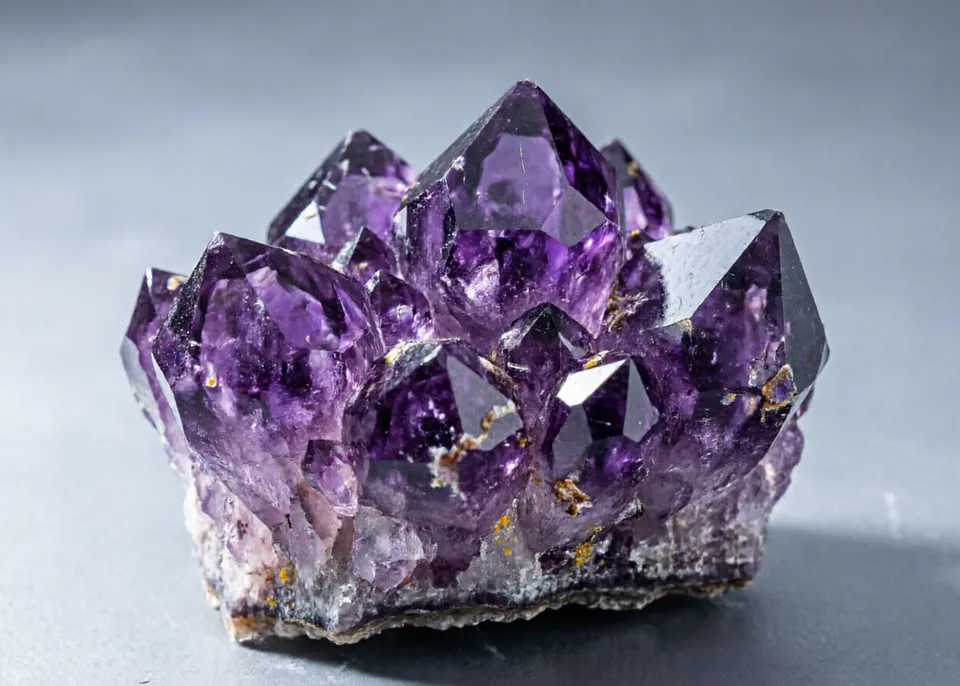
What is amethyst?
Amethyst is the purple variety of quartz (SiO₂). It belongs to the trigonal crystal system and has a Mohs hardness of 7, making it durable enough for everyday jewelry. Its density is about 2.65 g/cm³ and its refractive index ranges from 1.54 to 1.55.
The name "amethyst" comes from the Greek amethystos, meaning "not intoxicated"—a reference to the ancient belief that wearing amethyst could prevent drunkenness.
Why is amethyst purple?
The purple color is typically associated with trace iron, radiation-induced color centers, and crystal lattice defects—the specific mechanism varies by sample. Fe³⁺ substitution combined with natural radiation is a common explanation, but no single mechanism accounts for every amethyst's color.
Amethyst shows strong pleochroism—its purple can shift between reddish and bluish tones depending on the viewing angle. Natural amethyst often contains gas-liquid two-phase inclusions (called "ice cracks" or "cotton" in the trade). These features can provide preliminary clues, but they cannot replace refractive index, specific gravity, microscopic examination, and laboratory testing for a definitive identification.
Where does amethyst come from?
Major sources include Brazil (the world's largest producer), Uruguay (known for deep purple crystals), Zambia, Madagascar, and China. It typically forms in gas cavities (geodes) within volcanic basalt, or in pegmatite veins where silica-rich hydrothermal fluids cooled slowly over millions of years.
Treatments and how to spot them
Heat treatment is the most common: heating amethyst to about 240–270°C (464–518°F) turns it yellow or brown, producing what is sold as citrine. This is permanent and should be disclosed by the seller.
Synthetic amethyst exists and is grown in labs. Natural amethyst may show Brazil-law twinning (under crossed polarizers), irregular color zoning, and natural inclusions. Synthetic amethyst tends to be more uniform. Glass imitations may have bubbles or swirl marks.
Important: Inclusions, twinning, and color zoning can provide preliminary clues, but they cannot replace refractive index, specific gravity, microscopic examination, and laboratory testing for a definitive identification. Treat visual clues as starting points, not final answers.
Jewelry and wearing tips
Amethyst is cut into faceted gems for rings and pendants, carved into beads, or polished as cabochons. With hardness 7, it's suitable for daily wear—but avoid:
- Prolonged strong light or heat, which may cause some amethyst to fade—especially color-sensitive or treated samples. Brief daily wear does not usually cause immediate fading.
- Sudden temperature changes (thermal shock can crack it)
- Ultrasonic cleaners unless you are certain the stone has no internal fractures
Clean with warm soapy water and a soft cloth. Store separately from harder gemstones (diamond, sapphire, ruby) to prevent scratches.
If charging is part of your personal practice, choose a dry, low-impact method and consider the whole bracelet—not only the stone. The amethyst bracelet charging FAQ separates ritual choices from physical cleaning and covers elastic, glue, metal, heat, and light risks.
Cultural beliefs and symbolism
Amethyst has carried meaning across many cultures—these are cultural and folkloric traditions, not scientifically verified properties:
- Ancient Greece: Believed to prevent intoxication; goblets were carved from amethyst.
- Medieval Europe: Associated with royalty and the church; bishops wore amethyst rings as a symbol of piety.
- February birthstone: In Western tradition, amethyst symbolizes sincerity, peace, and love.
- Chinese tradition: Purple represents nobility; amethyst is seen as a stone of wisdom and good fortune.
What affects amethyst's value?
Price is determined by color saturation, clarity (eye-clean stones command higher prices), cut quality, and size. Deep, even purple tones are generally more desirable in the market, but terms like "Siberian purple" are commercial descriptions—they cannot by themselves prove origin or value. Most top-grade amethyst today comes from Uruguay and Zambia.
Before buying: ask the seller to confirm the material identity, treatment status (heated or natural), dimensions, and return policy in writing.
Use this guide as a starting point
For a costly or disputed stone, ask for species, treatment, and origin information in writing. An independent laboratory report is stronger evidence than a marketing phrase.
Return to Quartz & SilicaSources: GIA Amethyst reference and the GemVerity editorial method. This is an educational guide, not a gemological identification report. Cultural beliefs described above are folkloric traditions, not scientific guarantees.