Stone library / Chatoyant quartz
Hawk's Eye
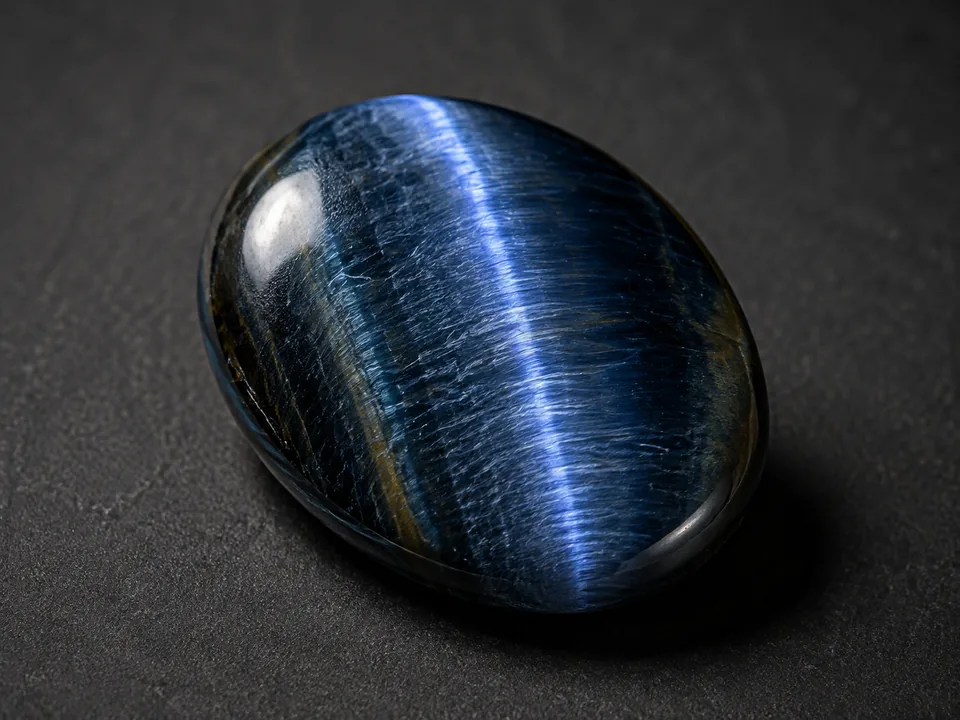
Hawk's Eye is a market name for blue chatoyant quartz material related to Tiger's Eye. The moving band, color, fiber pattern, treatment status, and condition should be assessed together; the name alone is not a mineral identification.
1. Identity and definition
Hawk's Eye is a market name for blue chatoyant quartz, generally associated with partially silicified fibrous material related to Tiger's Eye. It is a trade description rather than a standalone mineral species.
2. Composition and color
Blue color is linked to preserved or less oxidized fibrous structure, while further alteration can produce the golden-brown appearance of Tiger's Eye. The moving band is a chatoyant optical effect.
3. Sources and geological setting
South Africa, Australia, Brazil, and China are among the sources reported in trade. It occurs in silica-replaced fibrous rock, sometimes with quartz and iron-bearing alteration minerals. Origin should be documented.
4. Treatment and natural status
Dyeing, coatings, resin, and glass imitations may be sold under similar names. A blue color or bright band does not prove natural material or lack of treatment.
5. Cutting and jewelry use
The material is usually cut as a cabochon with the fiber direction aligned across the dome. Beads, pendants, and protected rings are common. A low-profile setting helps prevent edge damage.
6. Meaning and emotional context
Blue chatoyancy is often used to symbolize focus, courage, and perspective. Claims about anxiety relief, radiation protection, or decision-making are folklore or marketing, not quartz properties.
7. Market context and value
Prices depend on the sharpness and movement of the band, color, pattern, size, polish, treatment, and provenance. Compare the optical effect and condition, not just the trade name.
8. Astrology, folklore, and care
Star signs, water symbolism, chakras, and protection claims are cultural context. Quartz is around 7 and reasonably wearable, but avoid harsh chemicals, hard impact, and prolonged direct sun if color stability is unknown.
Practical buying and care answers
What to check first
Ask whether the color is natural, dyed, coated, stabilized, or imitated. Quartz is relatively hard, but cabochon edges, fractures, and settings still need impact-aware care; use gentle cleaning and avoid harsh chemicals when treatment is unknown.
Evidence boundary: A photograph, seller nickname, locality story, or cultural claim cannot by itself prove species, origin, treatment, value, or performance.
Frequently asked questions
Can a photograph identify Hawk's Eye?
No. A photograph can show appearance but cannot by itself prove the material, origin, treatment, construction, or value.
What should I ask before buying?
Ask for the exact material name, treatment status, condition, measurements, report details when relevant, care limits, and return terms.
How should I care for it?
Use conservative, material-appropriate cleaning and avoid impact, harsh chemicals, and unverified ultrasonic or steam cleaning.
Use this guide as a starting point
For a costly or disputed stone, ask for species, treatment, and origin information in writing. An independent laboratory report is stronger evidence than a marketing phrase.
Return to the stone librarySources: GIA Gem Encyclopedia and the GemVerity editorial method. Last reviewed: 2026-08-09. This is an educational guide, not a gemological identification report.