Stone library / Trade name for included quartz
Super Seven Quartz
A careful guide to Super Seven Quartz, why the seven-mineral claim is not a reliable identification rule, and how to buy and care for it.
1. Identity and definition
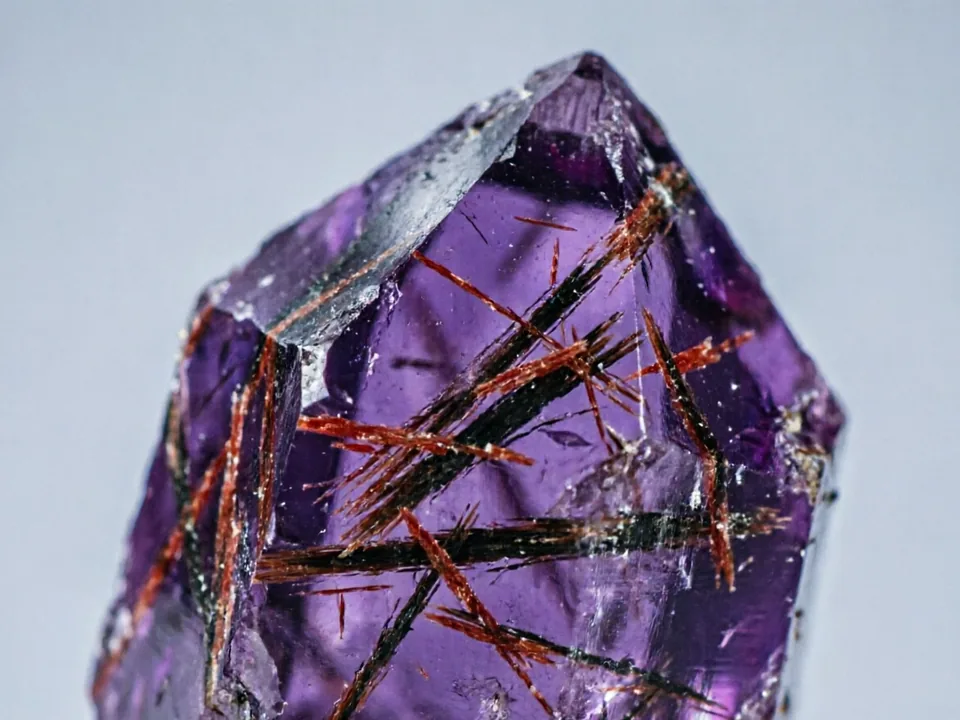
Super Seven (also sold as Melody Stone or Sacred Seven) is a popular commercial trade name for a highly included variety of quartz. The marketing claim is that the stone contains exactly seven minerals: Amethyst, Cacoxenite, Goethite, Lepidocrocite, Rutile, Smoky Quartz, and Clear Quartz. However, this is a commercial concept, not a gemological reality. Most pieces sold under this name contain only two or three of these minerals (usually amethyst with goethite or hematite inclusions), and a specimen cannot be authenticated by trying to count the number seven under a microscope.
2. Composition and color
Quartz is silicon dioxide. Purple color may relate to amethyst, while red, brown, dark, or needle-like inclusions can have different mineral identities. Exact inclusions require examination rather than a seller checklist.
3. Sources and geological setting
Brazil is commonly cited in the trade, particularly Minas Gerais, but origin cannot be established from color or internal texture alone. Quartz veins and pegmatite-related environments can host varied inclusions.
4. Treatment and natural status
Dyeing, coatings, fracture filling, heat treatment, and glass imitations may occur. Treat the seven-mineral story as a commercial claim unless a qualified report identifies the inclusions.
5. Cutting and jewelry use
Beads, cabochons, freeform pendants, and specimen pieces are common because internal texture is the visual focus. Avoid heavy impact, sharp points, and high-stress ring settings.
6. Meaning and emotional context
Crystal sellers often use language about multiple energies, cleansing, or whole-body balance. Those ideas may be personal or cultural, but they are not mineral functions or health claims.
7. Market context and value
Price is driven by transparency, inclusion pattern, color, damage, size, polish, provenance, and treatment. Do not pay a premium solely for an unverified seven-mineral count.
8. Astrology, folklore, and care
Chakra, comprehensive-energy, and fortune associations are crystal culture. Quartz is around 7, but inclusions and fractures can lower durability. Avoid prolonged strong sun, high heat, hard impact, and harsh chemicals.
Use this guide as a starting point
For a costly or disputed stone, ask for species, treatment, and origin information in writing. An independent laboratory report is stronger evidence than a marketing phrase.
Return to the stone libraryEducational guide only, not a gemological identification report. See our method and care guides.