Gemstone comparison
Moonstone vs Labradorite: How to Tell These Feldspars Apart
Moonstone usually shows a soft, floating glow called adularescence, while labradorite shows broader, directional sheets or patches of color called labradorescence. Both belong to the feldspar group and both are commonly listed around 6 to 6.5 on the Mohs scale. The biggest label trap is “rainbow moonstone,” a trade name commonly used for transparent or pale labradorite rather than traditional orthoclase moonstone.
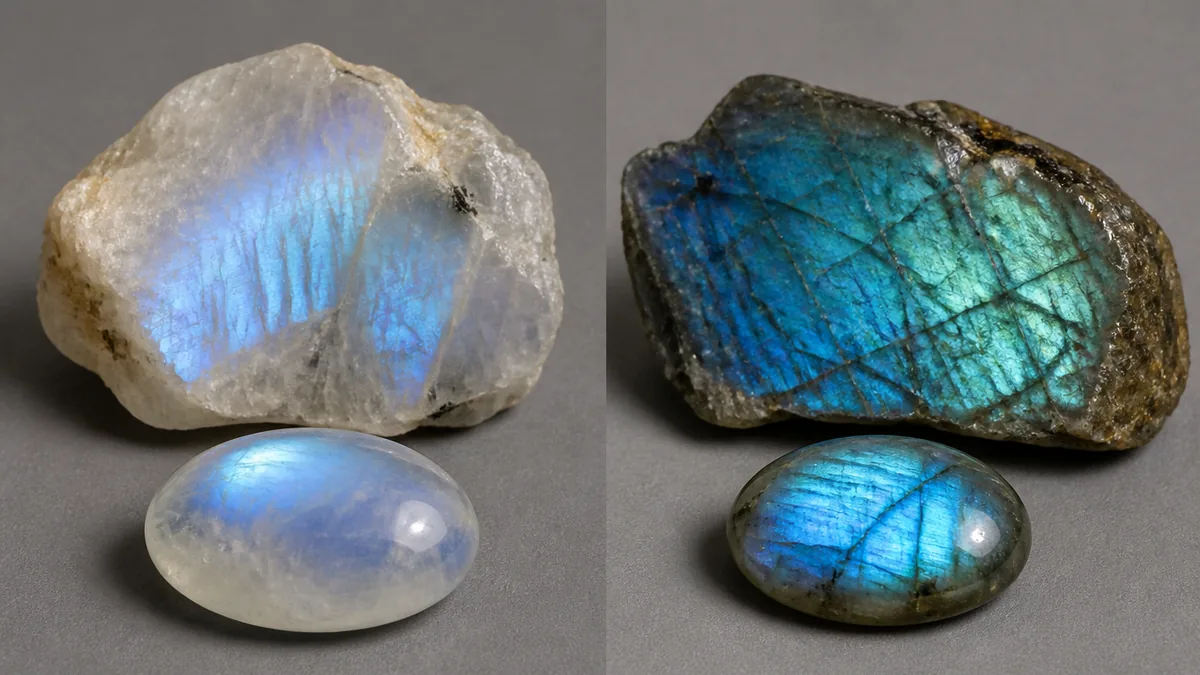
Moonstone vs labradorite at a glance
| Feature | Moonstone | Labradorite |
|---|---|---|
| Feldspar context | Traditionally associated with orthoclase and albite intergrowths | A plagioclase feldspar, commonly calcium-sodium rich |
| Signature effect | Adularescence: a soft glow that appears to float below the surface | Labradorescence: directional sheets or patches of spectral color |
| Typical body color | Colorless, white, cream, gray, peach, brown, or green | Gray to dark gray, colorless, pale, or yellowish beneath the flash |
| Mohs hardness | About 6–6.5 | About 6–6.5 |
| Main buying confusion | “Rainbow moonstone” may be pale labradorite | Flash may disappear outside the seller’s lighting angle |
The scientific difference: adularescence vs labradorescence
The visual effect is a useful preliminary clue, but it is not a complete laboratory identification. In moonstone, light scattering through fine internal feldspar layers can create a softer glow with less sharply defined boundaries. Fine blue-sheen material may show concentrated blue light over a nearly colorless body, while other moonstones show white or silvery sheen.
Labradorite more often displays broad planes, bands, or patches that switch on and off as the stone moves. Blue and green are familiar, but gold, orange, and multicolor effects also occur. Dark body color can increase contrast, yet body color alone does not establish identity.
Photography can exaggerate either effect through a narrow light angle, dark surroundings, saturation, or selective framing. Ask for a neutral-light video that rotates the entire stone through several angles. A single hero image proves only that the seller found one favorable view.
Rainbow moonstone vs labradorite labels
“Rainbow moonstone” is widely used in jewelry retail for transparent or pale labradorite with blue or multicolor labradorescence. The name is commercially familiar, but it can blur the mineral distinction between that material and traditional moonstone associated with orthoclase-albite intergrowths.
Do not treat the trade name alone as evidence of fraud. Instead, ask the seller to state the mineral identity, whether the stone is natural or synthetic, and whether it has coatings, fracture filling, dye, or other treatment. Dark inclusions can occur in pale labradorite, but inclusions by themselves are not a conclusive home test. For more label examples, see the misleading crystal trade names guide and the broader feldspar gemstone overview.
Which is better for jewelry?
Choose by the effect, condition, and setting rather than assuming one feldspar is universally tougher. Both materials are commonly listed at about 6 to 6.5 Mohs. Mohs hardness measures scratch resistance, not resistance to impact, cleavage, or existing fractures. Feldspars have cleavage, so a hard knock can chip or split a stone even when its surface has resisted ordinary scratches.
- Rings: Prefer a bezel, halo, or other protective setting, especially for a high cabochon. Remove the ring for lifting, sports, gardening, and impact-heavy work.
- Pendants and earrings: These usually face fewer knocks, making either material more practical for frequent wear.
- Bracelets: Inspect exposed edges and bead holes because repeated contact with desks and hard surfaces can cause damage.
Clean conservatively with lukewarm water, mild soap, and a soft cloth or brush, then dry thoroughly. Avoid steam and ultrasonic cleaning when identity, treatment, fractures, or assembly are uncertain. A qualified jeweler should assess valuable, damaged, or heavily included pieces.
Buying checks before you choose
- Request the exact identity. Ask whether the listing means traditional moonstone, pale labradorite sold as rainbow moonstone, or another feldspar.
- Watch a full rotation. Compare the effect in neutral light and note how much of the stone flashes, not just the brightest frame.
- Inspect condition. Look for edge chips, surface-reaching fractures, scratches, glue, and damage around drill holes or prongs.
- Ask about treatment. Confirm whether coatings, dye, filling, backing, or assembled construction are present.
- Judge the setting. Protective metalwork matters more for rings than for pendants or earrings.
- Check the return policy. Directional effects can look different in person, so clear return terms reduce the risk of lighting-driven disappointment.
Meanings and folklore
Moonstone is often associated in modern crystal traditions with intuition, cycles, and new beginnings, while labradorite is linked with transformation and protection. These are cultural and folkloric beliefs, not scientific or medical facts. They should not replace mineral identification, professional care advice, or medical treatment.
Frequently asked questions
Is rainbow moonstone actually labradorite?
In much of the jewelry trade, “rainbow moonstone” refers to transparent or pale labradorite with blue or multicolor labradorescence. Ask for the exact mineral identity rather than relying on the trade name alone.
Which is more durable, moonstone or labradorite?
Both are commonly around 6–6.5 on the Mohs scale and both need protection from impact because feldspar cleavage can contribute to chipping or splitting. Setting design, fractures, and wear conditions matter more than a small stated hardness difference.
Why does my labradorite have no flash?
Labradorescence is highly directional. Rotate the stone under a single light source; some pieces show color only across a narrow angle, while others naturally have weak or limited flash.
Can appearance alone prove which feldspar I have?
No. The effect and body color provide clues, but overlapping appearances, trade names, treatments, and photography can confuse home identification. Seller documentation or gemological testing is more reliable for valuable or uncertain stones.
. See the GemVerity editorial method for how we separate mineral facts, trade terminology, and folklore.