Jewelry guide / rose quartz
Rose Quartz Bracelet: Meaning, Care & Buying Guide
Editorial disclosure: GemVerity provides independent educational guidance. This page does not promise medical, emotional, or spiritual outcomes.
A rose quartz bracelet is best understood as pink quartz jewelry with a long-standing association with affection, compassion and self-care. Those meanings belong to cultural and crystal traditions—not clinical evidence. For buyers, the practical questions are whether the material is accurately described, whether the hardware suits the wearer, and whether the construction can handle daily use.
Quick answer
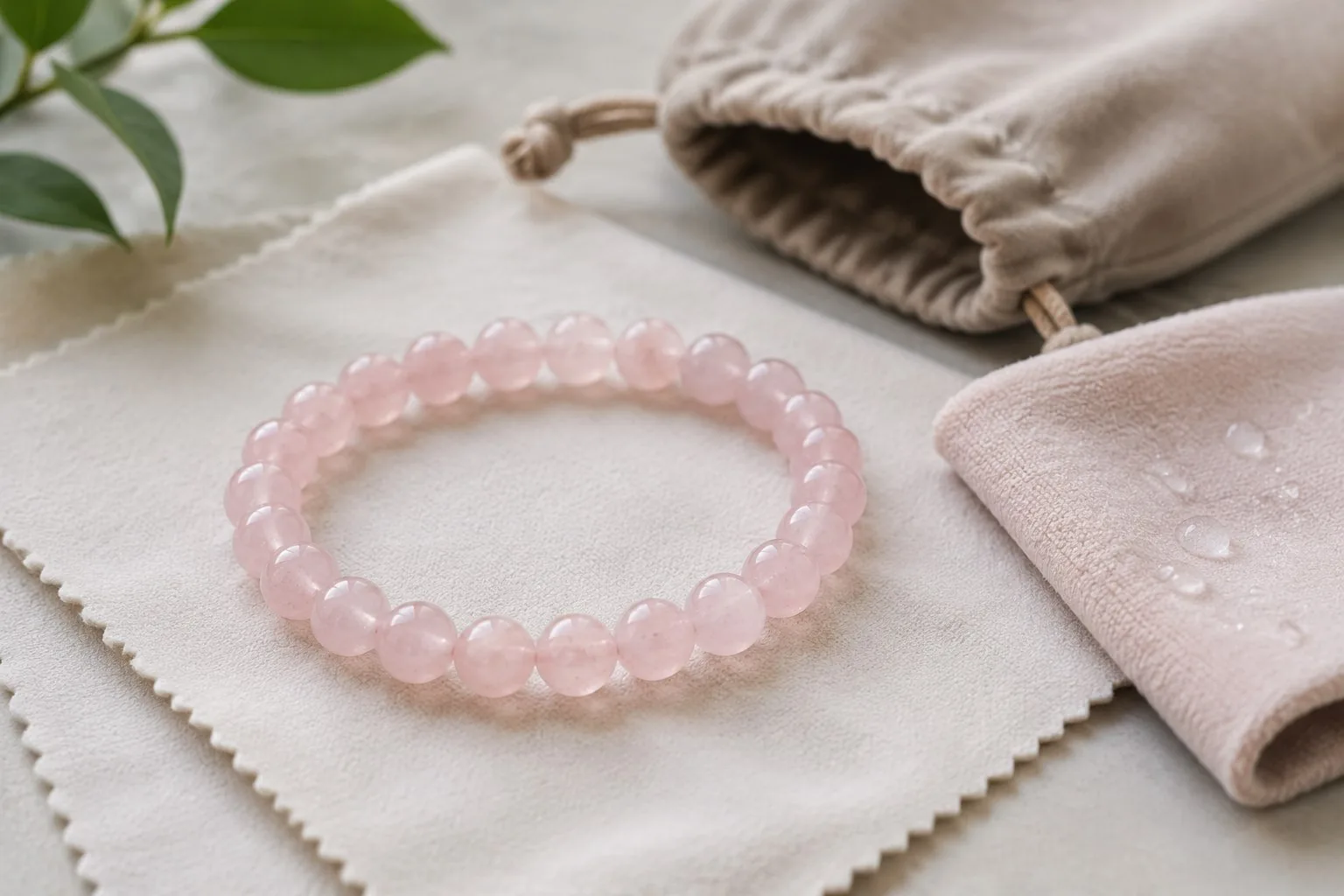
Rose quartz has Mohs hardness 7, so polished beads resist everyday scratching reasonably well, but a bracelet can still chip, fade, stretch or fail at its cord and metal parts. Remove it for swimming, showering, exercise, cleaning chemicals and impact-heavy work. Clean it briefly with lukewarm water, mild soap and a soft cloth, then dry it thoroughly.
Rose quartz bracelet facts at a glance
| Question | Practical answer |
|---|---|
| Material | Rose quartz, a pink variety of quartz (SiO₂) |
| Hardness | 7 on the Mohs scale; this measures scratch resistance, not overall toughness |
| Typical appearance | Pale to medium pink, commonly translucent and slightly cloudy |
| Traditional meaning | Affection, compassion and self-care in modern crystal traditions |
| Daily-wear concern | Cord, drill holes, clasps, plating and spacers may fail before the beads do |
| Sensitive-skin concern | Ask for the exact metal composition; “silver tone” and “hypoallergenic” are not precise material descriptions |
What does a rose quartz bracelet mean?
In contemporary crystal and New Age traditions, rose quartz is associated with love, emotional gentleness, compassion and the heart chakra. A bracelet may therefore serve as a personal symbol or reminder. These interpretations are cultural beliefs; there is no established scientific evidence that wearing rose quartz treats trauma, changes relationships or produces a measurable healing effect.
The meaning can still be personally useful when it is framed honestly. A wearer might choose the bracelet to mark a relationship, a self-care routine or a gift from someone important without treating the stone as medical care.
What natural rose quartz usually looks like
Rose quartz is a pink variety of quartz that most often occurs in massive material rather than sharply formed transparent crystals. Its color is linked to microscopic mineral inclusions and structural color centers; the cause should not be reduced to a simple “titanium, iron or manganese” formula.
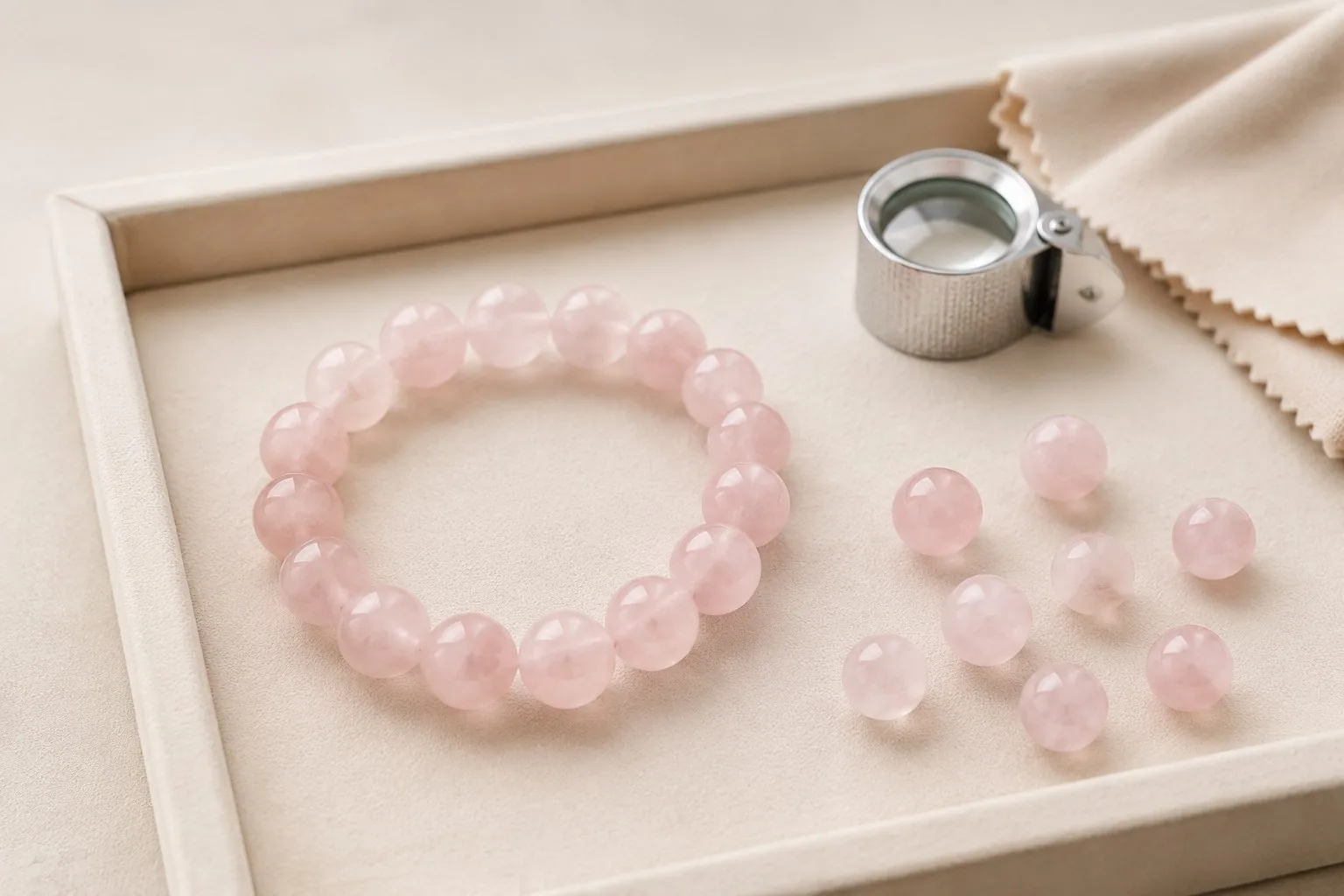
Bracelet beads commonly show soft translucency, cloudy zones, internal veils and modest color variation. Those features can be consistent with natural material, but they are not proof. Glass, dyed quartz and other pink materials can imitate parts of the appearance.
For the mineral background and source references, read the GemVerity rose quartz guide.
How to choose a rose quartz bracelet
- Ask for an exact material description. The listing should distinguish natural rose quartz from dyed quartz, glass, coated material or another pink stone.
- Check photos in neutral light. Heavy saturation and warm filters can make pale beads look much pinker than they are.
- Inspect construction. Look for smooth drill holes, secure knots or crimps, an appropriate cord thickness and a clasp that closes cleanly.
- Verify every metal component. Ask about clasps, wire, spacer beads and plating—not only the main decorative metal.
- Review sizing and returns. Bead diameter does not determine wrist fit; use the stated bracelet length or wrist range.
- Treat “grade” labels cautiously. Terms such as AAA are not a universal independent grading system for rose quartz beads.
Rose quartz bracelets and sensitive skin
Skin reactions are more likely to involve metal alloys, plating, residues, trapped moisture or friction than the polished quartz bead itself. However, no bracelet should be described as universally safe or non-reactive for every wearer.
“925 sterling silver” means the alloy contains 92.5% silver, but the remaining alloy and any plating still matter. Titanium can be a useful option when its grade and composition are clearly disclosed. If you have a known metal allergy, ask the seller for complete material information and follow medical advice rather than relying on a broad “hypoallergenic” claim. See the GemVerity guide to jewelry metals and sensitivity claims for the same material-checking principles.
Can a rose quartz bracelet get wet?
Brief contact with clean water is unlikely to damage an intact rose quartz bead, but the whole bracelet is a mixed-material object. Repeated soaking can weaken elastic, affect adhesives, accelerate wear on plating and leave moisture around metal fittings.
| Exposure | Recommendation | Why |
|---|---|---|
| Hand washing | Occasional splashes are usually manageable; dry the bracelet promptly | Protects cord and metal components |
| Shower or bath | Remove it | Soap, heat and repeated soaking shorten construction life |
| Pool or hot tub | Remove it | Chlorine, heat and chemicals can affect cord, plating and fittings |
| Sea water | Remove it | Salt and prolonged wetting are unnecessary risks for assembled jewelry |
For a broader comparison, see which crystal bracelets are water-safe.
How to clean and store it
- Check for loose beads, frayed elastic, open jump rings or damaged plating before cleaning.
- Wipe with a soft damp cloth. If needed, use a small amount of mild soap and lukewarm water.
- Avoid long soaking, bleach, acids, abrasive cleaners, steam and ultrasonic cleaning unless a qualified professional has assessed the complete bracelet.
- Dry the beads, drill holes and metal parts thoroughly.
- Store separately in a soft pouch away from harder gems and prolonged strong sunlight.
Mohs hardness does not make every cleaning method safe. Read the general crystal jewelry cleaning guide before cleaning an unidentified, treated or damaged piece.
How to “cleanse” it without confusing belief and care
Moonlight, smoke and intention-setting are spiritual or personal rituals, not gemological cleaning methods. If you use them, keep fire, ash, oils and moisture away from elastic and metal components. A dry, non-contact ritual is less likely to damage the bracelet than salt water, burial or prolonged soaking.
Physical dirt still requires ordinary jewelry care. The guide to cleansing and charging crystal bracelets separates ritual practices from material safety.
Frequently asked questions
Can I wear a rose quartz bracelet every day?
Yes, with reasonable care. Remove it for exercise, impact-heavy work, swimming, showering and chemical exposure. Inspect elastic and clasps regularly.
Does a rose quartz bracelet have healing properties?
Rose quartz has traditional associations with love and emotional comfort, but wearing it is not an evidence-based treatment for physical or mental health conditions.
How can I tell whether a rose quartz bracelet is real?
No single home test proves identity. Ask for the exact material and treatment disclosure, compare neutral-light photos, check the return policy and seek a qualified gemologist for a valuable or disputed piece.
Is rose quartz safe for sensitive skin?
The metal, plating, cord, residues and fit are usually more relevant than the quartz bead. Verify all components and avoid universal hypoallergenic promises.
Will sunlight fade rose quartz?
Some rose quartz can lose color with prolonged strong light or heat. Store it away from a sunny window and do not use direct sunlight as a routine cleansing method.
Related styling guide
Already own the bracelet? Try these five everyday rose quartz bracelet stacks, with practical guidance on proportion, watches, materials and friction.
Bottom line
Choose a rose quartz bracelet for its appearance, craftsmanship and personal symbolism—not a guaranteed healing claim. The strongest listing identifies the stone and every metal component, shows realistic photos, explains sizing and offers clear care and return terms.
Sources and editorial boundary
Last reviewed: 2026-08-28. This article provides educational buying and care guidance, not gemological identification, medical advice or a guarantee of spiritual results.