Crystal bracelets / buyer guide
Crystal Bracelet Guide: Real vs Fake, Fit, Care & Meaning
Start with the bracelet, not the promise. A useful crystal bracelet decision begins with what the beads and hardware are, how the piece is strung, whether it fits, and how it will be worn. Meaning can make a bracelet personally important, but it should not replace material disclosure, construction checks, or ordinary jewelry care.
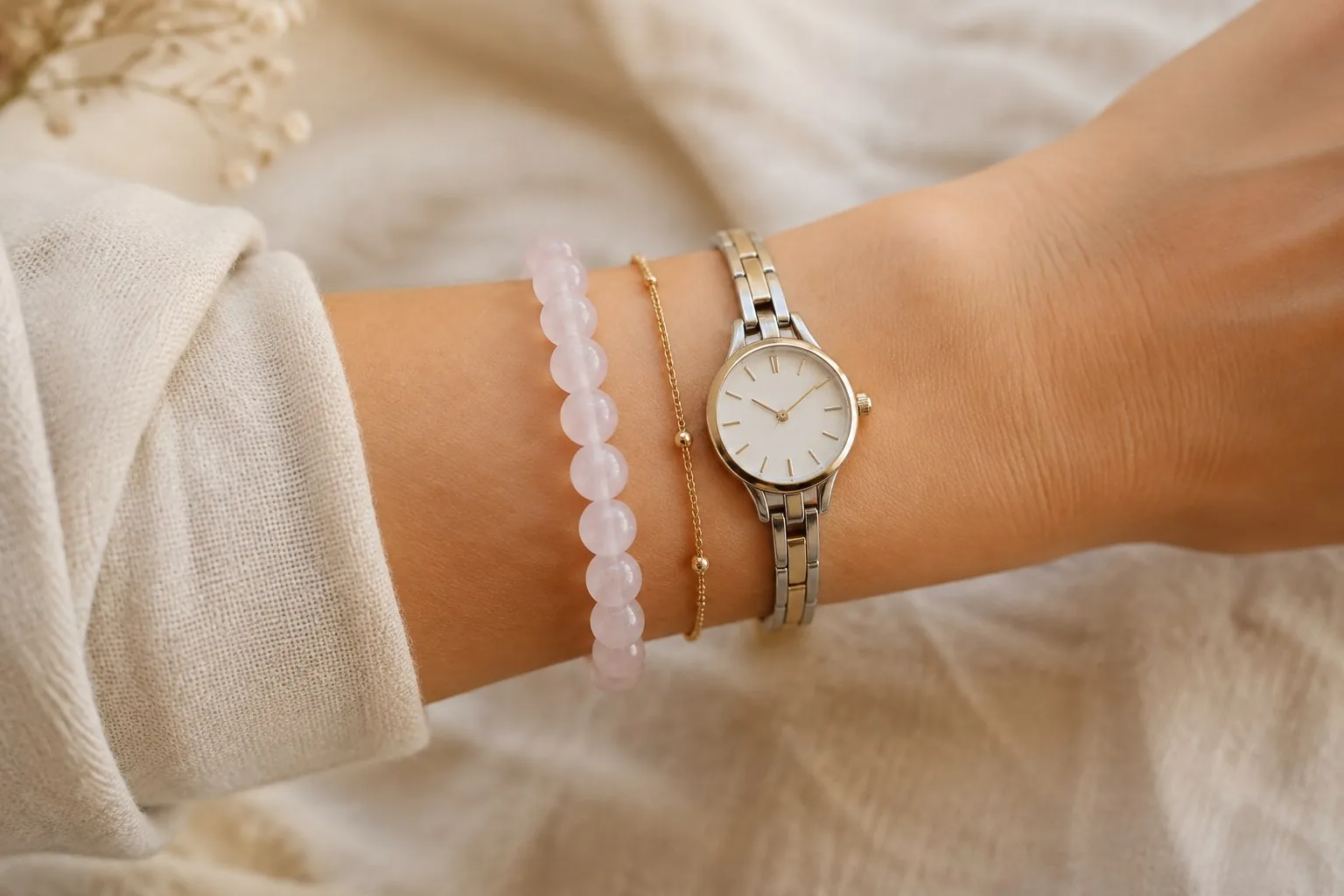
Quick answer: what matters most
Buy the disclosed material and construction, not the word "crystal." Ask for the exact stone or material, any treatment, bead size, wrist fit, stringing method, and every metal component. Treat left-versus-right wrist rules and energy meanings as cultural or personal frameworks. Remove the bracelet before showers, swimming, exercise, and harsh cleaning, and inspect the elastic or cord regularly.
No photo can prove that a bracelet is natural, untreated, or worth its price. Color, inclusions, and surface shine can support a conversation about identity, but gemological testing requires instruments and a qualified professional when the value or dispute justifies it.
What does "crystal bracelet" actually mean?
"Crystal" is used loosely in jewelry retail. It may describe a mineral with a crystalline structure, a polished stone bead, a glass product, a resin imitation, or a mixed-material bracelet with a poetic trade name. The word alone does not identify a mineral species or establish that the beads are natural.
| Label you may see | What it can mean | What to ask next |
|---|---|---|
| Natural crystal | A claim about geological origin, but not necessarily treatment status | Which mineral or variety, and has it been heated, dyed, irradiated, coated, filled, or assembled? |
| Lab-grown or synthetic | A laboratory-created material with a disclosed origin | What is the exact material, and is the seller using "lab-grown" and "imitation" as if they mean the same thing? |
| Glass, resin, or reconstituted stone | A different material from a natural mineral crystal | Is the material disclosed clearly in the listing and on the receipt? |
| Healing grade | A seller-created phrase with no universal grading standard | What observable criteria does the seller use, and can they state the mineral and treatment? |
| AAA or premium grade | Often an in-house descriptor for beads or specimens | Which features are being graded: color, clarity, size, surface, matching, or something else? |
For more examples of ambiguous terminology, read Crystal Buying Terms Explained. For the difference between natural origin and treatment, see natural vs treated gemstones.
Real vs fake crystal bracelets: what you can check
There is no single home test that proves every bead is genuine. A useful buying process separates four questions: identity (what material is it?), origin (natural, laboratory-grown, or imitation?), treatment (was it heated, dyed, coated, filled, or assembled?), and construction (how is the bracelet held together?).
| Question | Useful evidence | What it still does not prove |
|---|---|---|
| Is the stone what the seller says? | Exact mineral or variety name, consistent descriptions, close-up video, seller history, independent report when warranted | That every bead matches or that the material is untreated |
| Is it natural? | Clear written disclosure; laboratory documentation for high-value or disputed pieces | That the color is natural or that the stone has no treatment |
| Is the color stable? | Disclosure of dye, coating, heat, irradiation, or filling; care instructions | Permanent color under every light, chemical, or wear condition |
| Is the bracelet well made? | Smooth drill holes, suitable cord, secure knots or crimps, clean spacers, consistent bead alignment | That the elastic will last a fixed number of months |
Inclusions, clouds, color zoning, and surface variation can be consistent with natural material, but they are not a universal authenticity certificate. Glass, treated stones, and assembled products can also show internal features. A seller's confident photo caption is not a laboratory result.
What photos and videos cannot prove
Photos are useful for comparing color, shape, bead matching, surface condition, and visible hardware. They are weak evidence for refractive index, specific gravity, treatment, origin, or exact species. Filters and lighting can also change color substantially.
- Ask for neutral-light photos or video with the bracelet on a plain background and beside an object for scale.
- Ask for close-ups of the drill holes, knots, clasp, and spacers, not only the most flattering side.
- Ask whether the image is a representative stock photo or the exact bracelet that will ship.
- Do not rely on scratch, burn, smell, or "energy" tests promoted in social posts; some can damage the piece and still fail to identify it.
For a valuable, inherited, or disputed bracelet, use a qualified gemologist or laboratory rather than asking a comment section to identify it from one image.
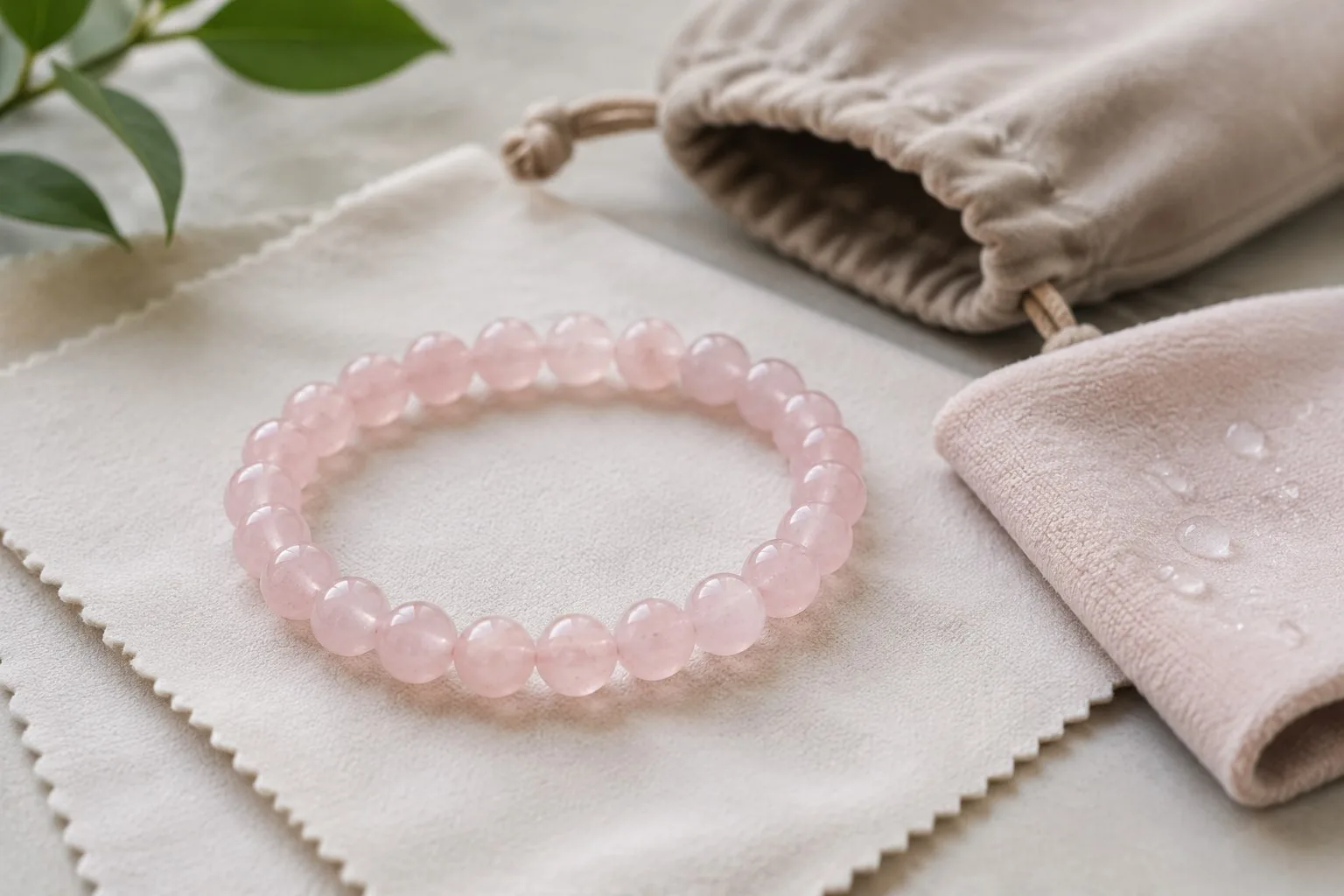
Do crystal bracelets really work?
There is no established scientific evidence that wearing a crystal bracelet produces a measurable healing, protective, financial, or relationship effect. Those meanings belong to cultural traditions, spiritual practices, and personal ritual. A bracelet can still be meaningful as a reminder, a gift, or a comforting routine without making a medical or outcome claim.
People may feel calmer or more focused when a piece carries personal significance, but that experience does not prove that the mineral caused a physical or psychological change. Do not use a bracelet as a substitute for medical care, mental-health support, safety decisions, or financial advice.
If meaning matters to you, use it deliberately: choose a stone whose story you enjoy, connect it to a habit you value, and keep the language honest. The meaning-by-intention index is a cultural starting point, not a promise of results. For a style-led guide to luck stones, red string, jade, evil-eye charms, and outfit pairings, read the good luck jewelry guide.
Which wrist should you wear it on?
In some crystal traditions, the left wrist is described as receptive and the right as expressive or protective. That is a symbolic convention, not a mineral property or a medical rule. Either wrist can be practical if the bracelet fits securely and does not interfere with your routine.
Choose the side with less repeated impact, better comfort, and less risk of the bracelet catching on clothing or equipment. If you follow left-right folklore, treat it as personal ritual. Read the full left-versus-right wrist guide for the cultural framing and practical fit checks.
Fit, elastic, and construction
Bead diameter alone does not determine wrist fit. A listing should state bracelet length or wrist range, closing method, and whether the fit is intended to be snug or relaxed. A bracelet that is too tight traps moisture and stresses the string; one that is too loose slides over the hand or strikes nearby objects.
- Elastic: convenient, but it stretches, dries, and weakens with wear, sweat, water, and repeated pull-over-hand use.
- Knotted cord: adjustable and traditional, but the cord can fray, absorb moisture, or loosen over time.
- Clasp and chain: easier to put on without stretching, but the clasp, jump rings, and ends become wear points.
- Drill holes: rough or sharp edges can abrade the string from the inside, even when the beads look fine.
- Spacers and charms: metal edges, plating, and added weight can increase friction or discomfort.
Inspect the bracelet when it arrives and then periodically. Replace frayed, sticky, or permanently stretched elastic before it fails. For repair steps, see what to do when a crystal bracelet breaks.
Water, sweat, and everyday care
The safe answer depends on the whole bracelet, not just the bead. Water can affect elastic, cord, adhesives, plating, metal spacers, and some treatments even when the mineral itself is durable. Quartz varieties such as amethyst and rose quartz are about 7 on the Mohs hardness scale, but hardness measures scratch resistance, not water safety or toughness.
| Situation | Conservative approach | Why |
|---|---|---|
| Brief accidental splash | Blot dry and inspect the string and metal | A splash is different from soaking |
| Hand washing | Remove if soap or repeated water is likely | Residue can collect around beads and fittings |
| Shower or bath | Remove | Heat, soap, shampoo, and repeated wetting stress the whole piece |
| Swimming or hot tub | Keep it off | Chlorine, salt, heat, and chemicals may affect stringing and finishes |
| Exercise or heavy work | Remove | Sweat, impact, and abrasion increase wear |
For physical cleaning, begin with a soft dry cloth. If the stone, treatment, stringing, and metal parts are known to tolerate it, use a barely damp cloth or brief lukewarm cleaning with mild soap, then dry every drill hole and fitting. Avoid soaking, bleach, ammonia, abrasives, steam, and ultrasonic cleaning unless a qualified jeweler confirms the complete piece is suitable.
Read which crystal bracelets should stay dry and the general crystal jewelry cleaning guide. The hardness and toughness guide explains why a Mohs number is not a whole-bracelet durability rating.
Cleansing rituals vs. cleaning jewelry
Moonlight, smoke, visualization, and intention-setting are spiritual or personal practices. They are not proven methods of physical disinfection or gemological cleaning. If you use a ritual, separate it from jewelry care so that salt water, prolonged soaking, direct heat, burial, oils, or smoke do not damage elastic, cord, metal, or a treatment.
Physical dirt still needs ordinary cleaning. Keep flame away from elastic and cord, avoid saltwater soaks, and do not bury treated or metal-containing beads. The guide to cleansing and charging crystal bracelets explains safer low-contact options.
Buying checklist before checkout
- Ask for the exact material and variety. "Crystal" or "natural stone" is not enough for a meaningful comparison.
- Ask about treatment and assembly. Heat, dye, irradiation, coating, filling, reconstitution, and adhesives should be disclosed when relevant.
- Confirm bead size and wrist range. Use the stated length or range rather than guessing from a model photo.
- Check the stringing method. Ask whether the bracelet is elastic, knotted, wire-strung, or clasped, and whether it can be repaired.
- Verify every metal component. The clasp, spacers, charms, wire, and plating matter for comfort and care, not only the visible front.
- Review the return terms. Color and fit are hard to judge on a screen; a clear return window reduces the cost of being wrong.
- Reject unsupported guarantees. Be cautious with claims of permanent color, universal allergy safety, guaranteed healing, or a specific spiritual outcome.
Choosing a bracelet by stone or by person
If you already know the stone, start with its material and care limits: rose quartz, amethyst, labradorite, moonstone, and turquoise each raise different questions about color, inclusions, treatment, porosity, and wear.
If you are choosing a gift, start with the recipient's existing jewelry, wrist fit, metal tolerance, and daily routine. Use the Gemstone Gift Finder for a shortlist, then verify the material and construction before buying. For a dedicated example, read the rose quartz bracelet buying and care guide.
Frequently asked questions
How can I tell if a crystal bracelet is real?
No single photo or home test proves that every bead is natural and untreated. Ask for the exact material, origin, treatment, bead size, stringing method, and return terms; use a qualified gemologist or laboratory for a valuable or disputed piece.
Do crystal bracelets really work?
Crystal bracelets are meaningful in many cultural and personal traditions, but there is no established scientific evidence that wearing one produces a healing, protective, financial, or relationship outcome. Treat meanings as symbolism or ritual, not medical evidence.
Which wrist should I wear a crystal bracelet on?
The left-for-receiving and right-for-expressing idea is folklore, not a mineral rule. Either wrist is acceptable; choose the side that fits securely, feels comfortable, and receives less impact during your routine.
Can I shower with a crystal bracelet?
It is safer to remove it. Repeated water, soap, heat, sweat, and chemicals can affect elastic, cord, adhesives, metal parts, and some stone treatments even when the bead itself is durable.
How should I clean a crystal bracelet?
Start with a soft dry cloth. Use only a barely damp cloth or brief mild-soap cleaning when the stone, treatment, stringing, and metal are known to tolerate it, then dry every bead, drill hole, and fitting. Avoid soaking and harsh cleaners.
Why did my crystal bracelet stretch or break?
Elastic and cord are wearable components that stretch, dry, fray, or weaken with repeated pulling, water, sweat, chemicals, friction, and time. Inspect the stringing regularly and replace it before a break; a snapped bracelet is usually a construction failure, not proof of a spiritual event.
Build the shortlist from the person and the wear routine.
Choose the stone, fit, and construction around how the bracelet will actually be worn, then verify the seller's material and treatment language.
Open the Gemstone Gift FinderIdentification and treatment boundaries were checked against the GIA article on gemstone analysis and the GIA introduction to gem treatments. Care guidance is conservative and material-specific; it is not a test of your bracelet. Last reviewed: .