October birthdays + holiday gifting
October Birthstone Gifts: Should You Choose Opal or Tourmaline?
October has two widely recognized birthstones—opal and tourmaline—so the best gift depends less on a fixed “lucky” stone and more on the recipient's style, wear habits, and tolerance for care. Opal offers shifting color and a softer, more atmospheric look; tourmaline offers broad color choice and, in many jewelry designs, a more straightforward everyday-wear conversation. Use this guide for October birthdays, last-minute gifts, and early holiday shopping.
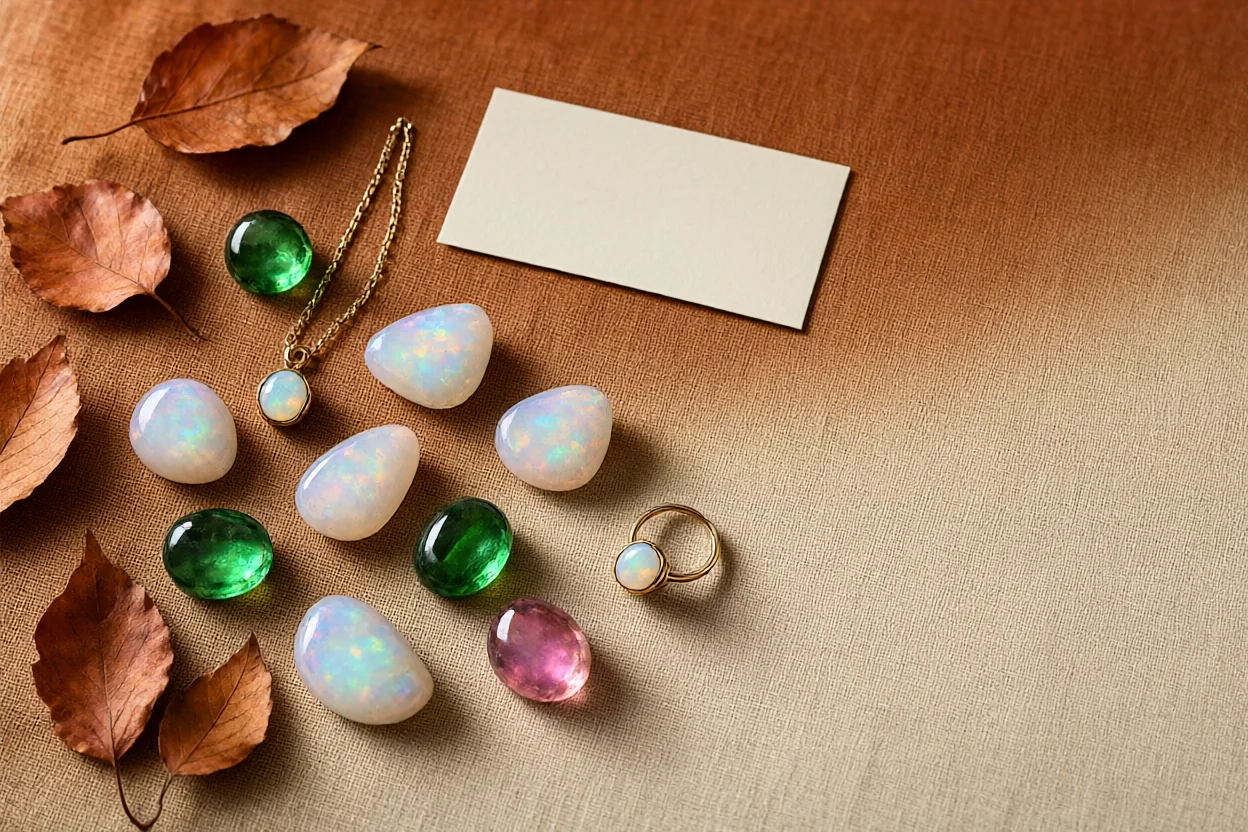
Opal vs tourmaline for an October birthday
| Choice | Best for | Gift mood | Check before buying |
|---|---|---|---|
| Opal | Someone who likes color play, softer glow, and distinctive pieces | Dreamy, artistic, iridescent | Solid opal vs doublet/triplet, treatment, fractures, body dryness, setting, and care instructions |
| Tourmaline | Someone who wants color variety or a more adaptable everyday design | Personal, modern, richly colored | Exact variety, treatment, color in neutral light, setting protection, and metal disclosure |
Why October has two birthstones
Birthstone lists are cultural systems, not a single universal scientific standard. Modern jewelry guides commonly associate October with opal and tourmaline. The two stones feel different in a gift: opal is about movement and changing color, while tourmaline can be vivid pink, green, blue, red, black, or multicolored depending on the variety and material.
In birthstone traditions, opal is often framed as imagination, hope, or emotional color, while tourmaline may be described through balance, creativity, or protection. These are symbolic associations that can help a giver choose a message; they are not evidence that a stone changes luck, health, relationships, or finances.
Choose opal when the recipient loves visual change
Opal suits someone who enjoys a stone that looks different as the light and viewing angle move. For a pendant or earrings, that play of color can be the entire design. A low-profile setting can also make the piece feel easier to wear than a tall ring.
Opal needs a more careful care conversation than a generic “birthstone jewelry” label suggests. Ask whether the piece is solid opal, a doublet, or a triplet; whether it has a coating or other treatment; and what the seller recommends for water, heat, chemicals, and cleaning. The opal buying guide explains the construction and care questions that matter.
Choose tourmaline when color and versatility matter
Tourmaline is a family of minerals with a wide palette, which makes it easier to match a recipient's favorite color or wardrobe. Pink and green can feel celebratory; blue can read cool and modern; watermelon zoning can make a gift look highly personal; black tourmaline can suit a minimalist or gothic style.
Do not assume a color name identifies a variety, origin, or treatment. Ask for the exact material description and whether the stone has been heated, irradiated, filled, coated, dyed, or assembled. For a high-value purchase, a report may matter more than a marketing adjective. Start with the tourmaline buying guide and, for copper-bearing blue material, the Paraíba tourmaline guide.
Three gift formats for last-minute shopping
1. A simple pendant
A pendant keeps the stone away from many desk and door impacts and works when you do not know the recipient's ring size. Choose a setting that holds the stone securely and ask whether the chain metal is solid, plated, filled, or vermeil.
2. Everyday earrings
Earrings can be practical for someone who prefers low-contact jewelry. For sensitive ears, look for a clearly stated post and backing material rather than relying on “hypoallergenic” alone. See the sensitive-ear materials guide.
3. A ring only when the recipient will care for it
Rings receive more knocks, soap, cosmetics, and temperature changes. Opal rings in particular deserve a direct care conversation. If the gift is meant for daily wear, ask about the setting, return policy, and whether the seller recommends removing it for sports, cleaning, gardening, or impact-heavy work.
Gift meaning without overpromising
A birthstone gift can carry a message such as “I celebrate your October birthday,” “your style is as changeable as opal color,” or “I chose this tourmaline because it matches your favorite green.” That is enough. You do not need to claim that a stone guarantees protection, attracts money, fixes a mood, or changes a relationship.
October birthstone buying checklist
- Confirm the stone. Ask whether the listing means opal, a composite opal, tourmaline, or a trade name.
- Ask about treatment and construction. Request written disclosure of coatings, dye, filling, backing, heating, irradiation, or assembly.
- Match the piece to the wearer. Choose pendant or earrings for low-contact use; choose a ring only if the care limits fit the recipient.
- Check the metal. Verify the exact metal composition, especially for sensitive ears or daily wear.
- Read the care and return terms. Keep a copy of the listing and confirm what happens if the appearance differs in person.
- Use the symbolism as a note, not a promise. Explain the cultural meaning you had in mind and keep the material facts separate.
For more occasion-based ideas, try the Gemstone Gift Finder or browse the birthstone-by-month index. Planning ahead? Compare citrine and topaz for a November birthday.
. Published for October 2026 birthdays and early year-end gift planning; update the seasonal framing next year.