Stone library / Other Silicate Gemstones / Chrysoberyl
Alexandrite
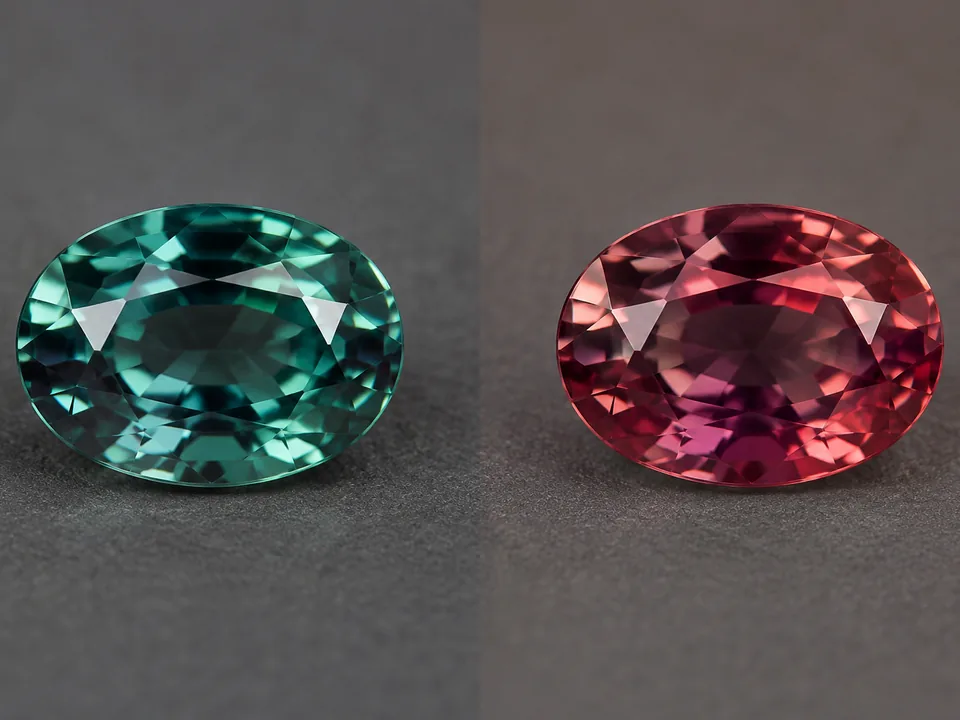
A rare color-change variety of chrysoberyl that shifts from green in daylight to red under incandescent light, earning it the nickname "emerald by day, ruby by night."
Short answer
Alexandrite vs chrysoberyl at a glance
Chrysoberyl is the mineral species, with the formula BeAl₂O₄. Alexandrite is a chromium-bearing variety of that species that shows a noticeable color change under different light sources. The names describe a family relationship, not two unrelated minerals.
| Feature | Alexandrite | Ordinary chrysoberyl |
|---|---|---|
| Mineral identity | Color-change variety of chrysoberyl | Chrysoberyl without the alexandrite designation |
| Typical appearance | Green, bluish green, or teal in daylight-type light; red, purplish red, or raspberry in warmer incandescent-type light | Often yellow, yellow-green, green, or brownish; a strong alexandrite-type change is not expected |
| Important cause of color | Chromium is central to the alexandrite effect | Color may involve iron and other trace elements |
| Other optical effects | Some rare stones also show a cat's-eye band | Chatoyant material is sold as cat's-eye chrysoberyl |
| Value context | Fine natural stones can be exceptionally valuable; strength of change, color, clarity, size, cut, treatment, and documentation matter | Usually less costly, although fine cat's-eye chrysoberyl can also be valuable |
What creates the alexandrite color change?
Chromium in the chrysoberyl crystal structure creates strong absorption in part of the visible spectrum, leaving transmission windows in both the blue-green and red regions. A light source rich in blue-green wavelengths can make the stone look green or teal, while a warmer source rich in red wavelengths can make it look red, raspberry, or purplish red.
The familiar phrase “emerald by day, ruby by night” describes an idealized result, not every natural stone. Real alexandrite varies in hue, saturation, and percentage of color change. A weak green-to-green shift is not enough evidence by itself, but neither can a photograph or a single rigid color rule prove that a seller has mislabeled a stone. Identification may require refractive-index, spectrum, magnification, and other laboratory observations.
Alexandrite, cat's-eye chrysoberyl, and look-alikes
Cat's-eye chrysoberyl is defined by chatoyancy: a moving band of light across a properly oriented cabochon. Alexandrite is defined by color change. Rare material can show both effects and may be described as cat's-eye alexandrite, but a visible eye alone does not make a stone alexandrite.
Color-change synthetic sapphire, glass, and other simulants have also been sold under confusing names. Genuine synthetic alexandrite is laboratory-grown chrysoberyl with essentially the same crystal structure and composition as its natural counterpart; it is not the same as a simulant. Ask whether a stone is natural, laboratory-grown, or an imitation, and request an independent gemological report for a costly purchase.
Where does alexandrite come from?
Alexandrite was first discovered in the Ural Mountains of Russia in 1830 and named in honor of the future Czar Alexander II. Those early Russian stones remain among the most historically significant alexandrite ever found.
Today the main commercial sources are Brazil, Sri Lanka, and East Africa. Brazilian material often shows a strong green-to-red shift, while different sources produce slightly different color characteristics.
Natural rarity and lab-grown alternatives
Natural alexandrite is extraordinarily rare and expensive, and fine stones with vivid color change are difficult to source in any size. Larger stones are even less common, and value rises sharply with carat weight.
Lab-grown alexandrite is also available. It has the same chemical composition and crystal structure as natural alexandrite and displays a similar color change, typically at a much lower price. The distinction between natural and lab-grown should always be disclosed, and it matters enormously to value.
How to judge alexandrite
Color change is the single most important factor. The most valuable stones show a strong, high-contrast shift between green and red. A smaller stone with a vivid color change is often more desirable than a larger stone with a muted one.
Clarity matters too, because a cleaner stone lets the color change appear sharper and brighter. Cut also affects the effect: a well-proportioned cut maximizes light return. Always view alexandrite under at least two light sources, natural daylight and warm incandescent light, before deciding.
Jewelry and care tips
With a hardness of 8.5 and no cleavage, alexandrite is durable enough for everyday wear and suits rings, pendants, and earrings. Clean with mild soap, warm water, and a soft brush.
Avoid harsh chemicals and extreme heat, especially in pieces that contain other, softer gemstones or delicate settings. Store separately from softer stones to minimize scratching.
Frequently asked questions
Is alexandrite a type of chrysoberyl?
Yes. Alexandrite is the chromium-bearing color-change variety of chrysoberyl. Chrysoberyl is the mineral species; alexandrite is a variety within it.
Does every alexandrite change from pure green to pure red?
No. Natural stones can appear bluish green, teal, yellowish green, raspberry, purplish red, or brownish red depending on the stone and light source. Strength and attractiveness of the change affect value, but exact colors alone do not establish identity.
Is laboratory-grown alexandrite real alexandrite?
It is genuine synthetic alexandrite when it is laboratory-grown chrysoberyl with the relevant color-change properties. It is not natural, and it should be disclosed as laboratory-grown or synthetic. Color-change sapphire, glass, and other look-alikes are simulants rather than synthetic alexandrite.
Can alexandrite have a cat's-eye effect?
Yes, rarely. A stone that shows both alexandrite color change and chatoyancy may be called cat's-eye alexandrite. Most cat's-eye chrysoberyl does not qualify as alexandrite.
Is alexandrite a type of beryl?
No. Despite the similar names, chrysoberyl and beryl are different mineral species. Beryl includes aquamarine, emerald, and morganite.
Cultural beliefs and symbolism
Alexandrite's visible color change has inspired modern associations with transformation, adaptability, balance, and joy. Some crystal and chakra traditions connect its green and red tones with emotional or spiritual themes, while yellow chrysoberyl may be linked with confidence or prosperity.
It is one of the official birthstones for June, alongside pearl and moonstone, and the traditional gemstone for the 55th wedding anniversary.
These are folkloric and cultural traditions.
What affects its value?
Value is driven first by the strength and contrast of the color change, with a clear green-to-red shift commanding the most. Clarity, cut quality, carat weight, and origin follow, and natural stones are worth far more than lab-grown material of the same appearance.
Sources: GIA chrysoberyl reference and the GemVerity editorial method. Last reviewed: 2026-08-21. This is an educational guide, not a gemological identification report.