Stone library / Feldspar / Orthoclase Feldspar
Moonstone
Everything you need to know about moonstone: what it is, where it comes from, how to spot treated stones, and how to wear and care for it.
Traditional birthstone: June (alternative).
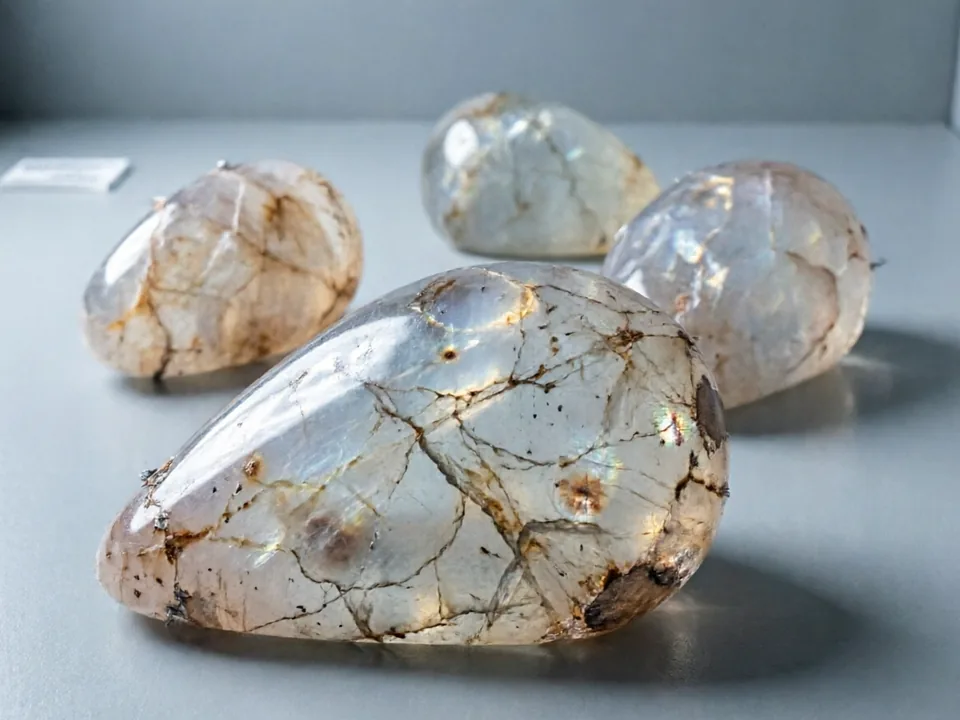
What is moonstone?
Moonstone is a feldspar gem known for adularescence, a floating light effect produced by fine intergrowth structures. Traditional moonstone is associated with orthoclase and albite feldspar layers rather than being defined by a chemical formula alone.
Common reference values are a Mohs hardness of 6–6.5, refractive index of about 1.518–1.526, and specific gravity near 2.58. These ranges help describe moonstone but do not authenticate a loose stone or finished piece by themselves.
What gives it its appearance?
Adularescence is the soft, billowing sheen that appears to move as the stone or light source changes. Body color may be colorless, white, gray, peach, brown, or green. A blue sheen can be desirable, but color and sheen alone do not establish species, origin, treatment, or value.
Where does it come from?
Moonstone is associated with deposits in several countries, including Sri Lanka, India, Myanmar, Madagascar, and Tanzania. Locality should be supported by seller documentation or laboratory evidence when origin materially affects the price.
Treatments and how to spot them
Moonstone is often sold without a treatment claim, but a finished piece can still be coated, dyed, fracture-filled, assembled, or mislabeled. Glass and other feldspars may also be marketed with moonstone-like names.
Important: A moving sheen is a useful observation, not a definitive home test. Refractive index, specific gravity, microscopy, and laboratory analysis provide stronger evidence. Ask for the material identity and any treatment or assembly in writing.
Jewelry and care tips
Moonstone has a Mohs hardness of 6–6.5 and cleavage that can make it vulnerable to sharp blows. Earrings and pendants are generally lower-impact choices; rings and bracelets benefit from protective settings and more careful wear.
GIA recommends warm soapy water and a soft brush for cleaning. Avoid steam and ultrasonic cleaners, and protect the stone from sudden temperature changes. Store it separately from harder gems and have loose settings checked by a jeweler.
Is rainbow moonstone true moonstone?
“Rainbow moonstone” is commonly used in the trade for transparent to pale labradorite, a plagioclase feldspar, rather than traditional orthoclase moonstone. Its multicolored flash can be attractive, but the commercial name can hide that mineralogical difference.
Use the labradorite guide for the underlying material, then compare the optical effects in moonstone vs. labradorite. A photograph may narrow the possibilities, but testing is needed when identity matters.
Cultural beliefs and symbolism
Moonstone carries cultural meaning across many traditions — these are folkloric and cultural traditions, not scientifically verified properties. Its associations vary by culture, and its use in astrology, chakra, or feng shui contexts should be understood as cultural expression rather than factual claims.
What affects its value?
Price is determined by color saturation, clarity, cut quality, and size. Before buying: ask the seller to confirm the material identity, treatment status, dimensions, and return policy in writing.
Use this guide as a starting point
For a costly or disputed stone, ask for species, treatment, and origin information in writing. An independent laboratory report is stronger evidence than a marketing phrase.
Return to FeldsparSources: GIA moonstone overview, GIA care guidance, GIA’s report on rainbow moonstone as plagioclase, and the GemVerity editorial method. This educational page is not a gemological identification report. Cultural beliefs are traditions, not scientific guarantees.