Stone library / category
Oxide, Halide and Specialty Gemstones
This category collects materials outside the silicate families: oxides such as corundum, spinel, and chrysoberyl, plus halides such as fluorite. They range from among the most durable jewelry stones to materials that are better protected from daily knocks.
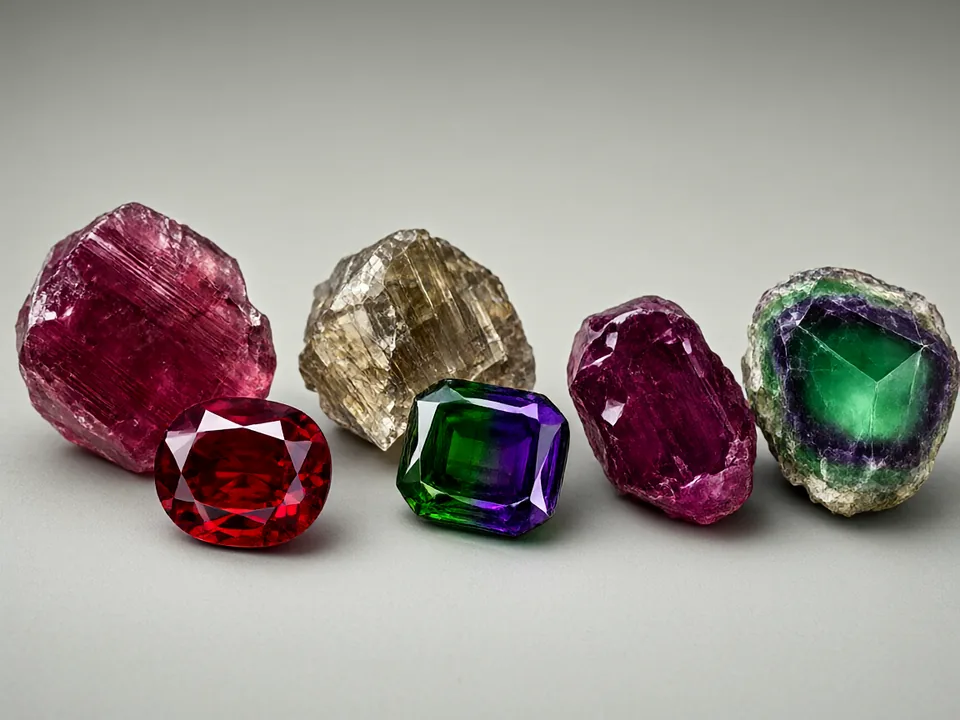
Materials in this family at a glance
| Name | What it is | Main buying question |
|---|---|---|
| Corundum (ruby, sapphire) | Aluminum oxide, around Mohs 9 | Is the color natural, and is heat, filling, or diffusion disclosed? |
| Spinel | Magnesium aluminum oxide, around Mohs 8 | Is it being sold as spinel, or as ruby or sapphire? |
| Chrysoberyl and alexandrite | Beryllium aluminum oxide, around Mohs 8.5 | Does documentation support the color-change claim and the variety name? |
| Fluorite | Calcium fluoride, around Mohs 4 with cleavage | Is the piece protected from knocks, heat, and cleaning chemicals? |
One category, very different durability
Corundum, spinel, and chrysoberyl are among the more durable jewelry materials. Fluorite is not: it is soft, has cleavage, and can be affected by heat and acids. Grouping them by mineral class is useful for identification, but it is a poor basis for a care rule.
Setting matters as much as the stone. A hard stone with an exposed girdle or a thin prong can still chip. A soft stone in a protected pendant may last well if the wearer accepts the limits.
Names that borrow value
Red spinel has a long history of being confused with ruby, and the confusion can be commercial rather than accidental. Synthetic alexandrite, color-change glass, and coated or treated stones can reproduce the most visible cue while failing the identity test. Fluorite is sometimes sold under decorative color names that say nothing about the mineral.
- Heat: common and often accepted for ruby and sapphire, but it should be disclosed.
- Fracture filling: changes care and value, and should be stated clearly.
- Diffusion and coating: surface or lattice treatments can create color that is not natural.
- Synthetic material: may have the same composition and still be a different product from a natural stone.
When a report earns its place
An independent report is most useful when the price depends on a claim that the eye cannot verify: species, treatment status, origin, or color change. Check that the report describes the exact piece, that the described weight and dimensions match, and that the laboratory is recognized for the question being asked.
Care by material
- Corundum, spinel, chrysoberyl: generally tolerant of routine cleaning when the setting and any treatment allow it; inspect prongs and edges.
- Fluorite: avoid ultrasonic and steam cleaning, sudden heat, acids, and impact; store separately.
- Treated stones: follow the treatment-specific limits rather than the species default.
Read hardness and toughness before assuming that a high Mohs number makes a piece carefree.
Spinel guide
Natural versus synthetic spinel, heat treatment, and ruby confusion.
Guide 02Alexandrite guide
Color change, chrysoberyl identity, rarity claims, and reports.
Guide 03Spinel vs ruby
Why a red spinel is not a ruby, however similar it looks.
Guide 04Natural vs treated
Heat, filling, diffusion, and coating change the buying question.
Guide 05Hardness and toughness
Corundum, spinel, chrysoberyl, and fluorite behave very differently.
Guide 06Gemstone hardness
Use hardness as a starting point, not a care guarantee.
Sources and limits
- GIA Gem Encyclopedia - species and treatment reference.
- GIA: Spinel - identity and history context.
- GIA: Alexandrite - color change and rarity context.
- GIA: Fluorite - material and care context.
- FTC Jewelry Guides - disclosure framework.
Last reviewed: 2026-11-05. This page is an educational category guide, not identification, origin, treatment, or valuation advice for a specific stone.